
By Kelly Wolfe, MSN, APRN, FNP-BC, CFMP · Updated September 26, 2026
Nasolabial folds and marionette lines are two of the most confused features on the lower face. They sit near each other, they both deepen with age, and they are often lumped together as “smile lines.” But they are anatomically different, they have different causes, and they call for different treatments.
In short: nasolabial folds run from the sides of the nose to the corners of the mouth and are mostly a volume and support problem. Marionette lines run downward from the corners of the mouth toward the chin and combine volume loss with a muscle that pulls the mouth corners down. That muscle is why marionette treatment often adds Botox®, while nasolabial folds are usually addressed with filler alone.
What is the difference between nasolabial folds and marionette lines?
Nasolabial folds are the two lines running from the base of the nose to the corners of the mouth, while marionette lines run vertically down from the corners of the mouth toward the jaw, so the difference is direction and location: nose-to-mouth versus mouth-to-chin.
The nasolabial folds run diagonally from the nose down to the corners of the mouth, while the marionette lines drop straight down from those same corners toward the chin, named for the hinged lines on a puppet’s chin. Both belong to the lower third of the face, but because they sit in different places and involve different anatomy, treating one does not treat the other.
What causes nasolabial folds?
Nasolabial folds deepen mainly from midface volume loss: as the cheek’s fat and bone support recede with age, the cheek settles downward and the fold at the nose-to-mouth crease becomes more pronounced.
The fold itself is a natural boundary between the cheek and the upper lip, so everyone has some crease there. It becomes a concern when the support above it weakens. With age, the deep fat pads of the midface shrink and descend and the underlying bone remodels, so the cheek loses its lift and presses down into the fold. Sun exposure and collagen loss thin the skin on top, which makes the shadow deeper. Because the root cause is often higher up in the cheek, the best correction frequently starts by restoring midface support, not by filling the line directly.
Why marionette lines form
Marionette lines come from a combination of volume loss around the mouth and chin and an overactive depressor anguli oris muscle, which actively pulls the corners of the mouth downward and etches a vertical line over time.
This is the key distinction. Marionette lines are not only a volume problem. A small muscle called the depressor anguli oris, or DAO, runs from the corner of the mouth down toward the jaw, and its job is to pull the mouth corner down. When it is strong or overactive, it drags the corners into a subtle frown and deepens the marionette line with every expression. Add the same age-related volume loss that affects the rest of the lower face, and the line becomes both a groove and a downturn. That two-part cause is why the treatment is usually two-part as well.
How are nasolabial folds treated?
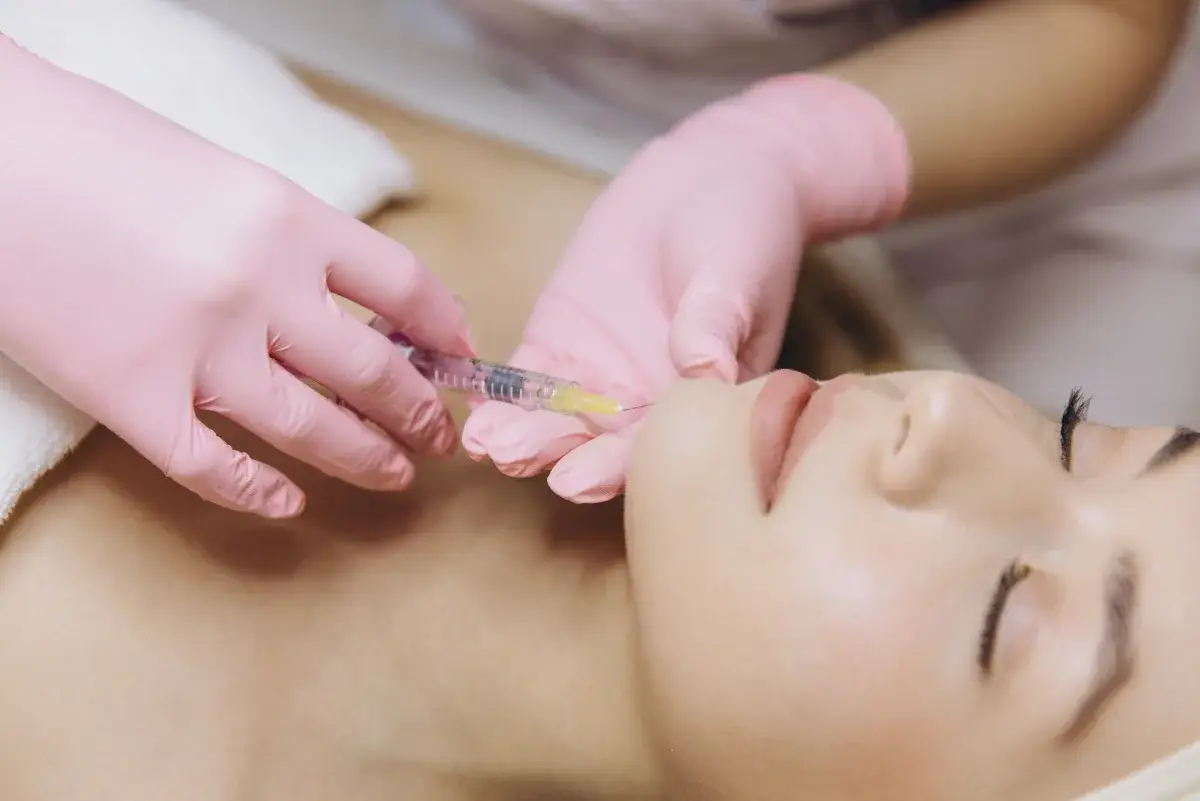
Nasolabial folds are usually treated by restoring the support that caused them, most often with a dermal filler or a biostimulator placed to lift the cheek and soften the fold, rather than by injecting directly into the crease.
Because the fold is frequently a downstream effect of midface descent, an experienced injector often treats the cheek first so the fold softens from above. Options include a biostimulator such as Radiesse®, which adds immediate structure and stimulates your own collagen over the following months, or Sculptra®, which rebuilds volume gradually across a series. For the right candidate, a targeted amount of filler can also soften the fold itself. Because the fold often begins with midface descent, correcting sunken cheeks in Miami Beach is frequently part of the plan. You can read more about treating nasolabial folds or see the full range on our fillers and biostimulators page.
Treating marionette lines
Marionette lines usually take a two-part approach: a biostimulator or filler to rebuild lost volume along the line, plus a small amount of Botox in the depressor anguli oris to release the muscle that pulls the mouth corners down.
Treating only the volume leaves the downward pull in place, and treating only the muscle leaves the groove. So the fuller correction combines them, which is the heart of our marionette lines treatment in Miami Beach. A biostimulator like Radiesse or Sculptra rebuilds the structure that has been lost around the mouth and chin, and a few units of Botox in the DAO ease the muscle that drags the corners down, which lets the mouth sit in a more neutral, relaxed position. Because Botox is involved, careful, conservative dosing keeps your smile natural.
A quick note on preparation: filler and biostimulator injections can bruise, and some patients ask about pausing blood thinners beforehand. If you take a blood thinner or antiplatelet medication such as aspirin, warfarin, Plavix, Eliquis, or Xarelto, talk with your prescribing physician before changing or stopping it. Never adjust that medication on your own.
What does it cost to treat nasolabial folds or marionette lines in Miami Beach?
Nasolabial fold and marionette line treatments are both priced by the product used: Radiesse runs about $800 to $1,100 per syringe and Sculptra about $900 to $1,200 per vial, with lower-face plans commonly using a few syringes or a short series, plus a small Botox charge when the muscle is treated for marionette lines.
Your total depends on how much volume needs to be rebuilt and whether a muscle component is involved. A marionette line plan may add a small amount of Botox for the DAO on top of the biostimulator, while a nasolabial plan is usually product alone. Radiesse gives immediate structure with collagen-stimulated improvement over three to six months and typically lasts 12 to 18 months. Sculptra builds gradually and can last up to two years. Per-product pricing is confirmed in writing before anything is injected, and your exact plan comes out of an in-person assessment.
Where to Find Us in Miami Beach
Our office sits on 5th Street at the northern edge of South of Fifth (SoFi), the southern tip of Miami Beach, about three blocks from Ocean Drive. Patients come to us from across Miami Beach, Brickell, Mid-Beach, and Bal Harbour.
1000 5th Street, Suite 414
Miami Beach, FL 33139
Frequently asked questions about nasolabial folds and marionette lines
What is the difference between nasolabial folds and marionette lines?
Nasolabial folds run from the sides of the nose to the corners of the mouth, while marionette lines run downward from the corners of the mouth toward the chin. Nasolabial folds are mostly a volume and support issue, whereas marionette lines also involve a muscle that pulls the mouth corners down.
What causes nasolabial folds?
Nasolabial folds deepen mainly from midface volume loss. As the cheek’s fat and bone support recede with age, the cheek settles downward and the crease between the cheek and upper lip becomes more pronounced, with thinning skin and sun exposure adding to it.
What causes marionette lines?
Marionette lines come from volume loss around the mouth and chin combined with an overactive depressor anguli oris muscle that pulls the corners of the mouth downward. That mix of a groove and a downturn is what gives them their puppet-like look.
What is the best filler for nasolabial folds?
There is no single best filler for everyone. Because nasolabial folds are often driven by cheek descent, many patients do best when the midface is supported first, using a biostimulator such as Radiesse or Sculptra, sometimes with targeted filler in the fold. The right choice is decided in a consultation based on your anatomy.
Can Botox treat marionette lines?
Botox alone will not fill the line, but a small amount placed in the depressor anguli oris muscle can release the downward pull on the mouth corners. It is usually combined with a biostimulator or filler that rebuilds the lost volume, so the two work together.
Can you get rid of nasolabial folds without surgery?
Yes. Nasolabial folds are commonly softened without surgery using biostimulators or dermal filler to restore support, along with collagen-building treatments and sun protection. Results vary by person, and candidacy is determined in consultation.

Kelly Wolfe
Kelly Wolfe, MSN, APRN, FNP-BC, CFMP, is a Florida-licensed nurse practitioner and the owner of South Florida Face and Body, where she personally performs every injectable treatment. She holds a Master of Science in Nursing from the University of Miami and a Master of Science in Biochemistry, and she plans lower-face treatment around facial anatomy, addressing the volume loss and muscle movement behind each line rather than simply filling it.
Treat the cause, not just the crease.
Meet Kelly →Not sure which lines you have? A consultation is the quickest way to map your nasolabial folds and marionette lines and build the right plan for each. Book a lower-face consultation in Miami Beach.