
A 60-second InBody body composition assessment read by a University of Miami-trained nurse practitioner with a Master's in Biochemistry — not handed to you on a sheet of paper and called done.
An InBody scan in Miami Beach at South Florida Face and Body measures your skeletal muscle mass, body fat percentage, visceral fat, segmental lean analysis, and basal metabolic rate in approximately 60 seconds. What separates us from every other InBody assessment near you is what happens after the scan: Kelly Wolfe, MSN, FNP-BC sits with you and explains what the numbers actually mean for your metabolism, your hormones, your weight loss plan, and your training. Most clinics hand patients a printout and walk away. We don't.
4.9 64 Google Reviews
OWNER · UNIVERSITY OF MIAMI-TRAINED · FL APRN #11005134
Skeletal muscle mass, body fat percentage, visceral fat level, intracellular and extracellular water (ECW/TBW ratio and phase angle), segmental lean analysis (5 segments), basal metabolic rate, and InBody Score.
60-second scan. Plan a 30–45 minute appointment total — scan, printout, and Kelly's clinical interpretation of every number.
Multi-frequency bioelectrical impedance (BIA) at three frequencies across five body segments. Non-invasive, painless, no radiation, no needles.
Clinically validated to correlate r ≈ 0.93–0.98 with DEXA scans. The practical clinical standard for body composition tracking.
Kelly Wolfe, MSN, APRN, FNP-BC — University of Miami-trained, Master's in Biochemistry. Every scan, every interpretation, every time.
$80 for a standalone InBody scan — including Kelly's clinical interpretation, not just a printout. Included free with medical weight loss, hormone therapy, peptide therapy, and concierge memberships.
Tracking medical weight loss (GLP-1, semaglutide, tirzepatide), monitoring hormone therapy results, training progress, screening for sarcopenia and visceral adiposity.
An InBody scan is a 60-second, non-invasive body composition test that measures your skeletal muscle mass, body fat, visceral fat, and total body water directly — instead of giving you one number that hides all of that under the word "weight."
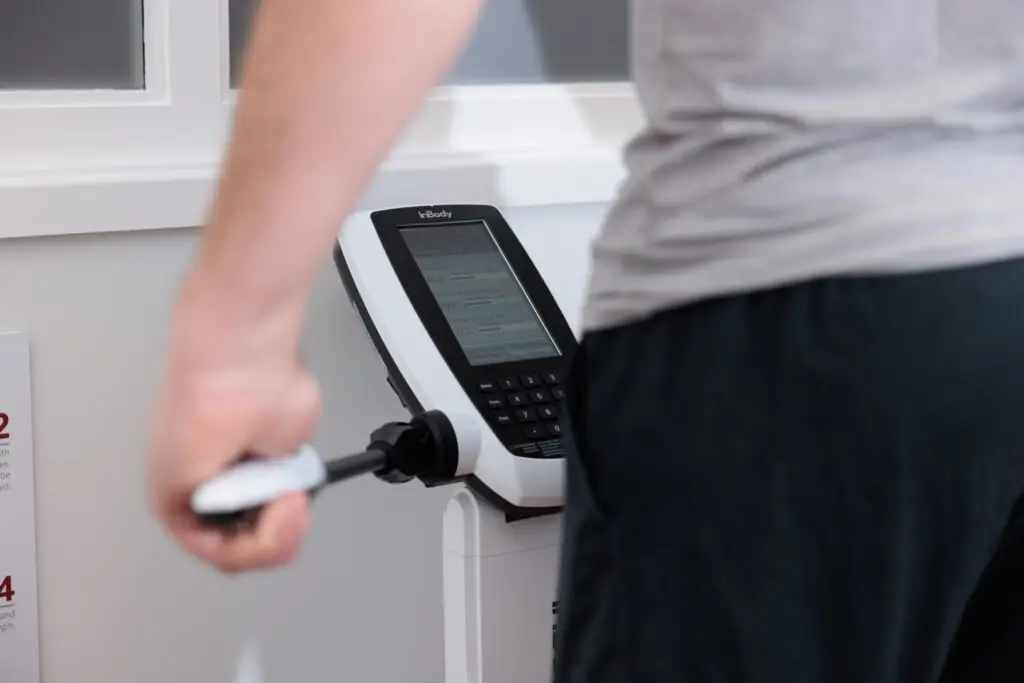
Your bathroom scale tells you a single number. That number is the sum of bone, organs, blood, water, fat, and muscle — but it can’t tell you which is which. The reason your weight bounces three pounds overnight is fluid shift. The reason the scale doesn’t move while your clothes start fitting better is that you’re trading fat for muscle. The reason your friend who weighs the same as you looks completely different is body composition. The scale is measuring the wrong thing.
An InBody scan replaces that single number with a precise breakdown of what your weight is actually made of. You see your skeletal muscle mass in pounds. You see your body fat in pounds and as a percentage. You see your visceral fat — the metabolically dangerous fat that wraps around your abdominal organs and drives cardiovascular and metabolic disease. You see your segmental lean analysis: muscle in your right arm vs left arm, right leg vs left leg, trunk. You see your total body water broken into intracellular (inside your cells, where lean tissue lives) and extracellular (between cells, where chronic inflammation shows up).
This matters in Miami Beach for one specific reason: a lot of the bodies on this beach look healthy and aren’t. Visceral fat doesn’t show up in a mirror. Sarcopenia (age-related muscle loss) often hides under a normal weight. Two patients with the same weight, same height, and same age can have completely different metabolic risk profiles. The InBody scan shows the difference.
An InBody 380 scan measures eight categories of data: body composition, muscle-fat analysis, obesity analysis, segmental lean analysis, ECW/TBW and phase-angle analysis, basal metabolic rate, visceral fat level, and your InBody Score. How does the InBody scan work? Multi-frequency bioelectrical impedance — three frequencies measured across five body segments — producing 15 separate impedance readings per scan.
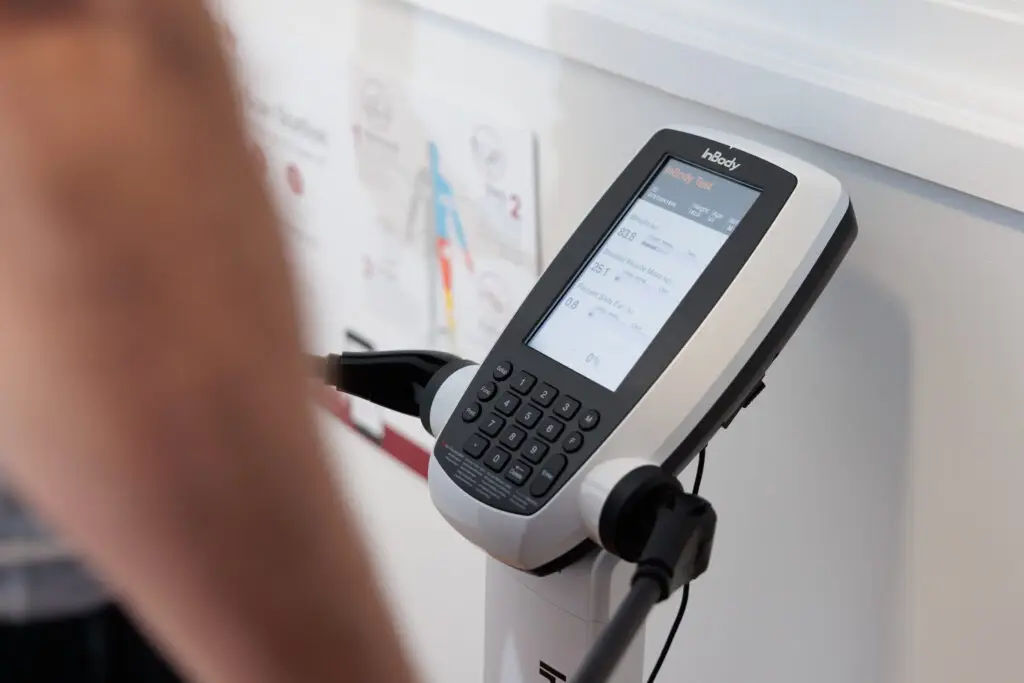
Here is what shows up on your InBody scan results printout, what each metric means, and why Kelly reads it the way she does:
Pounds of muscle attached to your skeleton — the muscle that moves you. This is the number to watch on GLP-1 medications and during weight loss in general. Losing SMM is losing metabolism.
Total fat in pounds and as a percentage of body weight. Healthy ranges depend on age and sex. Body fat percentage tells you far more than BMI ever will.
The metabolically dangerous fat around your organs, reported as a Visceral Fat Level. A level under 10 — roughly equivalent to 100 cm² of visceral fat area — is the clinical target. Visceral fat predicts metabolic disease far better than waist size.
Muscle mass in each arm, each leg, and your trunk individually. Reveals asymmetry, post-injury atrophy, and whether your training is actually balanced. Often surprises athletes.
Water inside cells (where lean tissue lives) vs water between cells. A high ECW/TBW ratio can flag inflammation, edema, or compromised cellular health — a clinical signal most patients have never seen.
The calories your body burns at complete rest. Calculated from your actual lean mass rather than an age-based formula — which is why this number drives Kelly's nutrition recommendations.
A composite score (typically 60–110) summarizing overall body composition health. 70 is average, 80+ is athletic, 90+ is exceptional. Useful as a single tracking number.
Side-by-side comparison of all metrics across every scan — fat down, muscle up, visceral fat trending. The reason we re-scan every 4–8 weeks during active treatment plans.
Most Miami clinics offering InBody scans hand you a printout, point at the headline number, and walk you to the door. That’s a vending-machine experience.
Kelly’s background is the difference. A Master’s in Biochemistry from Missouri State — with graduate research on metabolism, leptin, and appetite hormones — plus a Master of Science in Nursing from the University of Miami and a Certified Functional Medicine Practitioner credential, means the interpretation isn’t a pamphlet summary. It’s the conversation about why your ECW/TBW ratio is elevated. Why your right-leg lean mass is 3% behind your left. Why your visceral fat is climbing despite a normal BMI. Why your BMR is lower than the calculator predicted, and what that means for the macro plan you’ve been following for six months.
That’s the InBody assessment in Miami Beach you’re actually paying for. The scan is the easy part. The interpretation is what changes outcomes.
InBody's multi-frequency direct-segmental BIA — the technology in the InBody 380 we use in our office — is clinically validated to correlate r ≈ 0.93–0.98 with DEXA scans for body fat percentage and lean mass in most adult populations, making InBody the practical clinical standard for ongoing body composition tracking.
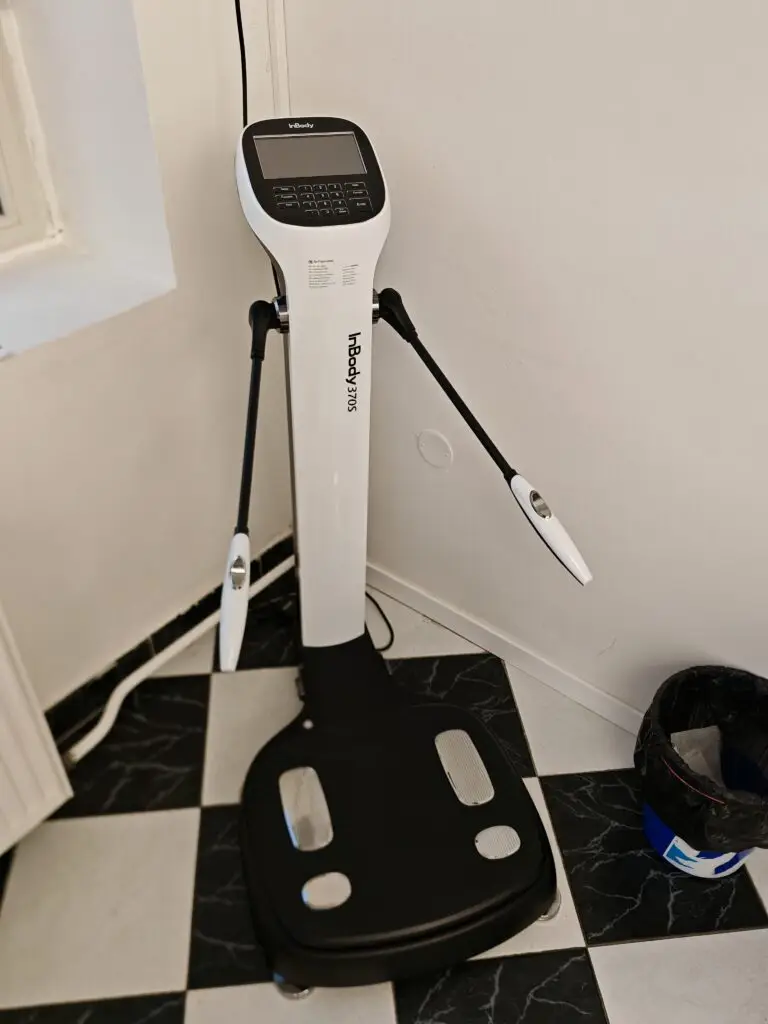
The honest answer: InBody is not DEXA, and InBody doesn’t need to be DEXA. DEXA (dual-energy X-ray absorptiometry) is the research gold standard. It uses low-dose X-rays to directly image tissue, includes bone density, and is the right tool when you specifically need bone data or are conducting research.
InBody uses multi-frequency bioelectrical impedance analysis (BIA) — three frequencies across five body segments, measuring 15 separate impedance readings per scan. It is dramatically more accurate than handheld BIA devices, single-frequency BIA scales, body fat calipers, and bod-pod estimations. For tracking change over time in a wellness setting — which is what 95% of patients actually need — InBody is faster, radiation-free, more affordable, and accurate enough to detect meaningful changes in muscle mass and fat mass within 4–8 weeks.
The accuracy caveat that matters: InBody accuracy depends on consistent scan conditions. Drink coffee before one scan and skip it before the next, and you’ll see a “change” that is actually hydration noise. That’s why Kelly walks every patient through prep before the first scan and re-scans at the same time of day, with the same prep, every time.
| InBody Scan | DEXA Scan | |
|---|---|---|
| Time to complete | ~60 seconds | 7–10 minutes |
| Radiation exposure | None | Low-dose X-ray |
| Accuracy vs gold standard | r ≈ 0.93–0.98 vs DEXA | Research gold standard |
| Body fat % | Yes | Yes |
| Visceral fat measurement | Yes (Visceral Fat Level) | Yes |
| Segmental lean analysis | Yes (5 segments) | Limited |
| Bone density | No | Yes |
| Cost in Miami | $80 (interpretation included) | $150–$300+ per scan |
| Best for ongoing tracking | Yes — every 4–8 weeks | Less practical |
Accurate body composition data depends on consistent scan conditions. Follow this InBody scan prep checklist — and bring the same prep to every re-scan so your numbers are actually comparable.
InBody scans are most valuable for patients on medical weight loss (GLP-1 medications like semaglutide and tirzepatide), patients on hormone therapy, athletes and serious trainees, anyone over 40 screening for sarcopenia, and anyone whose weight doesn't tell the metabolic story.

Your first InBody scan appointment is 30–45 minutes total: brief intake, the 60-second scan itself, printout review, and Kelly's interpretation of every number alongside your specific health goals.
Arrival. You’ll check in at 1000 5th Street, Suite 414 — in the South of Fifth district at the southern tip of Miami Beach. The parking garage is attached to the building at $4/hour, and free street parking is available around the building during business hours (one small section is pay-to-park).
Brief intake. Kelly will ask about your health goals, current medications, training, and what brought you in. If you’re new to the practice, she’ll review your medical history. If you’re on a medical weight loss plan, hormone therapy, or peptide protocol, she’ll pull your last scan for comparison.
The scan. Remove your socks, shoes, and jewelry. Step onto the InBody device barefoot, grip the hand electrodes, and stand still for approximately 60 seconds. You will feel nothing — the electrical currents are imperceptible. The printout prints immediately.
The interpretation. This is the part that takes the most time. Kelly walks through every metric on the printout — your skeletal muscle mass, body fat percentage, visceral fat level, segmental lean analysis, ECW/TBW ratio, BMR — and connects each number to where you are in your wellness plan. She’ll flag anything that’s changed since your last scan, anything that’s outside the healthy range, and anything that warrants adjustment to your nutrition, training, medication, or follow-up.
The plan. You leave with a clear understanding of what your numbers mean, what to track between now and your next scan, and a re-scan scheduled (typically 4–8 weeks out for patients in active treatment).
Same-week consultations available. South of Fifth, Miami Beach.
Kelly is the owner of South Florida Face and Body. A board-certified Family Nurse Practitioner trained at the University of Miami, she holds advanced degrees in nursing, biochemistry, and biology, with graduate research focused on metabolism and the role of leptin and appetite-suppressing hormones. She practices at the intersection of functional medicine and aesthetic injection — meaning the conversations in her treatment room often go beyond the syringe to consider sleep, hormones, metabolism, and inflammation as part of how your skin and face actually present.
Licensed as an Advanced Practice Registered Nurse in the State of Florida (APRN #11005134), Kelly brings more than three decades of experience in health, fitness, and clinical practice. She has performed aesthetic injections in South Florida for over a decade and has trained alongside the dermatology and plastic surgery community that built Miami’s aesthetic reputation.
She is the one who answers your text message. She is the one who calls the day after your injection.
From your first consultation through every follow-up, you’ll work directly with Kelly — one injector, one set of hands, one consistent plan.
Advanced practice registered nursing with a focus on family health and primary care.
Research focused on metabolism and the role of leptin and appetite-suppressing hormones.
Research with a strong foundation in human physiology, cellular biology, and biochemistry.
National certification in family practice and primary care.
Authorized to diagnose, treat, and prescribe medications in the State of Florida.
Advanced training in root-cause diagnostics, hormone optimization, metabolic health, and integrative wellness.
Over 30 years helping clients achieve sustainable health and wellness transformations.
Common questions from Miami Beach patients considering an InBody scan. If yours isn't covered here, send Kelly a message — she'll respond personally between patients.
A standalone InBody scan in Miami Beach at South Florida Face and Body is $80 — and unlike most clinics, that price includes a full clinical interpretation with Kelly Wolfe, MSN, FNP-BC. Most Miami clinics charge a similar amount for the scan alone and hand you a printout on the way out. Here, the $80 covers the scan plus Kelly’s time walking through every metric with you.
InBody scans are also included at no additional charge with our medical weight loss program, hormone therapy program, peptide therapy program, and concierge medicine membership. If you are already a patient in one of these programs, body composition tracking is part of the care, not an add-on.
The scan itself takes approximately 60 seconds. You step onto the InBody device barefoot, grip the hand electrodes, and stand still while the device runs.
Total appointment time is 30–45 minutes — that includes intake, the scan, the printout, and the part that actually matters: Kelly’s clinical interpretation of every metric in the context of your specific health goals.
InBody’s multi-frequency direct-segmental BIA — the technology in the InBody 380 we use in our office — is clinically validated to correlate r ≈ 0.93–0.98 with DEXA scans for body fat percentage and lean mass in most adult populations.
DEXA is the research gold standard. InBody is the practical clinical standard for ongoing tracking: faster (60 seconds vs 10 minutes), radiation-free, more affordable, and accurate enough to detect meaningful change within 4–8 weeks. The caveat is that InBody accuracy depends on consistent scan conditions — same time of day, same prep, same hydration state — which is exactly how we re-scan our patients.
A regular bathroom scale gives you one number — the sum of bone, organs, blood, water, fat, and muscle — without telling you which is which. The InBody scan breaks that single number into eight categories of measurement: skeletal muscle mass, body fat percentage, visceral fat level, segmental lean analysis, intracellular/extracellular water (ECW/TBW ratio and phase angle), basal metabolic rate, InBody Score, and body composition history.
This matters because two patients with the same weight, same height, and same age can have completely different metabolic risk profiles. The scale hides that. The InBody scan reveals it.
For the most accurate reading: no food or caffeine for 3–4 hours, no alcohol for 24 hours, no intense exercise for 6–12 hours, void your bladder right before, hydrate normally (don’t chug water last-minute), remove socks, shoes, and metal jewelry, and wear light clothing.
Do not stop any medication you are taking — including anticoagulants — without consulting your prescribing physician. Anticoagulants (aspirin, warfarin, Plavix, Eliquis, Xarelto, Pradaxa) do not affect InBody accuracy and should never be discontinued on your own for any test or procedure. Always speak with your prescribing physician before any anticoagulant change.
Caffeine is a diuretic and a vasoactive compound — it shifts fluid out of cells and increases peripheral blood flow temporarily. Because the InBody measures water distribution at three different frequencies to calculate lean mass and fat mass, caffeine within 3–4 hours of the scan can skew your total body water and intracellular/extracellular water ratios, which then distorts the lean mass and body fat calculations.
The fix is simple: have your coffee after the scan, not before.
It depends on what you’re tracking:
The rule that doesn’t change: re-scan under the same conditions (same time of day, same prep) every time, or the numbers aren’t really comparable.
Yes, the InBody scan is safe for the vast majority of patients. It uses a low-level, painless electrical current that is imperceptible. There is no radiation, no needles, no contrast, no recovery time.
The main contraindication is implantable electronic devices — pacemakers, implantable cardioverter-defibrillators (ICDs), neurostimulators, cochlear implants. Patients with these devices should not use InBody and should let Kelly know in advance so we can discuss alternative assessments. Pregnancy is also a relative contraindication for InBody scanning. Patients with metal joint replacements can typically be scanned but should disclose them so the data can be interpreted accordingly.
Our Miami Beach office is at 1000 5th Street, Suite 414 in the South of Fifth (SoFi) district. We are approximately 5 minutes from South Beach, 8 minutes from Brickell, 10 minutes from Mid-Beach and Downtown Miami, 15 minutes from Surfside, 19 minutes from Bal Harbour, 20 minutes from Key Biscayne and Coconut Grove, and 25 minutes from Sunny Isles and Coral Gables.
Phone: (786) 529-1860. Hours: Monday–Friday 10am–6pm, Saturday 10am–2pm.
The parking garage is attached to the building at $4/hour. Free street parking is available around the building during business hours (one small section is pay-to-park). Most patients park on the street without issue.
The InBody Score is a single composite number (typically 60–110) that summarizes overall body composition health relative to your weight and height. A score of 70 is average, 80+ is athletic, 90+ is exceptional.
The score reflects how much skeletal muscle mass you carry relative to body fat — it’s useful as a single tracking metric, but should always be read alongside the underlying numbers (SMM in pounds, body fat percentage, visceral fat level), which is what Kelly does at every interpretation.
InBody scans are typically considered a wellness service rather than a covered medical procedure, so they are usually out-of-pocket. However, HSA and FSA cards are commonly accepted for body composition assessments when billed as part of a medical evaluation — contact us at (786) 529-1860 to discuss your specific plan.
Within our concierge medicine membership and medical weight loss program, InBody scans are included in the program cost.
Covers your scan, lab orders, a follow-up visit with nurse practitioner Kelly Wolfe, and a personalized plan — credited to Optimal. Labs are billed separately (insurance, or ~$150–$300 self-pay at cost).