
Performed with SkinPen Precision — the only FDA-cleared Class II microneedling device — by a University of Miami-trained nurse practitioner who personally treats every patient.
Most microneedling performed in Miami Beach is cosmetic, not medical. Florida estheticians are restricted by law to superficial depths that don't reach the dermis where collagen and elastin live. Medical microneedling — the kind that actually addresses acne scars, sun damage, and significant pore size — must be performed by a licensed medical provider. Kelly Wolfe is a Florida-licensed APRN with the credentials and the medical-grade device to do it properly.
4.9 60 Google Reviews
OWNER · UNIVERSITY OF MIAMI-TRAINED · FL APRN #11005134
Acne scars, surgical scars, stretch marks, sun damage and pigmentation, enlarged pores, fine lines, mild skin laxity, hair loss (scalp). Safe for all Fitzpatrick skin types I–VI.
60–75 minute appointment (including 20–30 min topical numbing). Most patients return to errands the same day, though skin looks sunburned for 24–48 hours.
Initial glow at week 1. Real textural change visible at 2–4 weeks. Full collagen remodeling continues for 6 months. Series of 3–6 sessions spaced 4–6 weeks apart.
$400 per area (face, neck, décolleté, scalp, or comparable region) with SkinPen. Exosome add-on $200. PDRN add-on $200. Per-session pricing — no series pre-payment required.
Kelly Wolfe, MSN, APRN, FNP-BC — Florida APRN #11005134, University of Miami-trained. Florida-licensed medical provider. Every session, every appointment.
1000 5th Street, Suite 414 — South of Fifth, Miami Beach 33139. Attached parking garage ($4/hr) and free street parking around the building.
It is a clinical and legal distinction — and one most Miami Beach patients have never had explained to them. Understanding it is the difference between a session that actually works and one that doesn't.
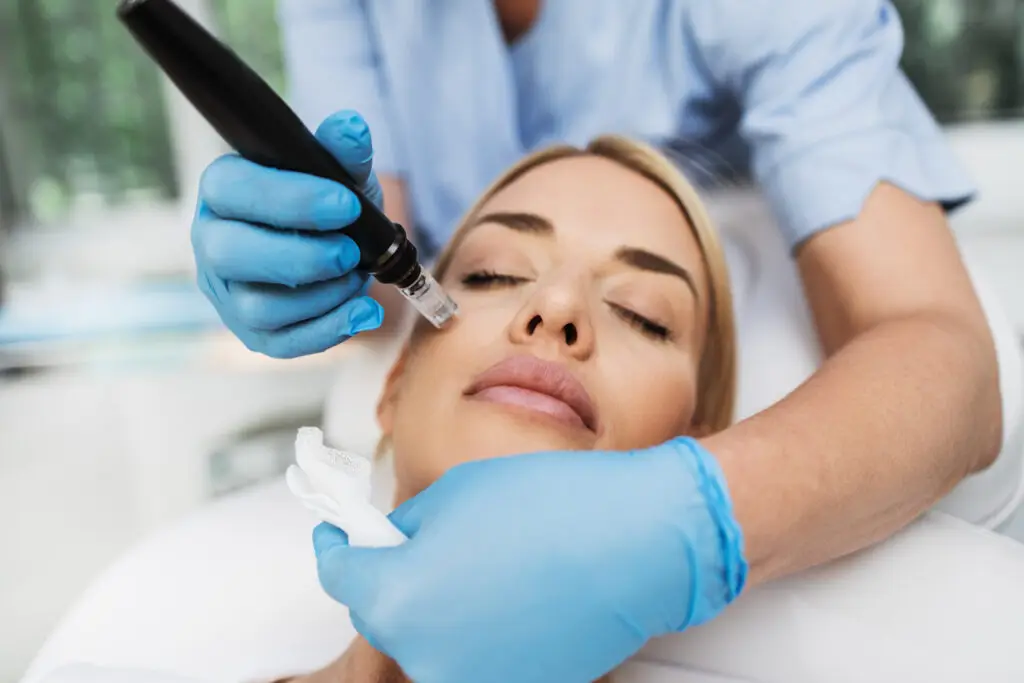
If you received microneedling at a Miami Beach med spa and walked away wondering why your acne scars looked the same, this is almost certainly why. The technique was technically performed; the depth required to address what you were paying to address was not. A medical microneedling session at South Florida Face and Body is a different procedure entirely.
When a microneedle penetrates the dermis, it severs no significant blood vessels but it does sever microscopic capillaries, releases growth factors (PDGF, TGF-β, VEGF, FGF), and recruits fibroblasts to the site of injury. Fibroblasts respond by laying down new type III collagen in the first 1–2 weeks, transitioning to the more durable type I collagen over 6–8 weeks, with peak remodeling continuing for 6 months.
This cascade only fires when the needle reaches viable fibroblasts. At 0.5 mm or less, much of the activity stays in the epidermis — useful for product penetration and surface glow, but not for the kind of tissue remodeling that softens a five-year-old acne scar.
MEDICAL DEPTH RANGE (FACE)
PEAK COLLAGEN REMODELING
FITZPATRICK TYPES SAFE TO TREAT
If you live in Miami Beach, you've probably been offered microneedling by an esthetician at a spa, a wellness center, or even a hair salon. In Florida, that procedure is legally constrained in ways most patients aren't told about.
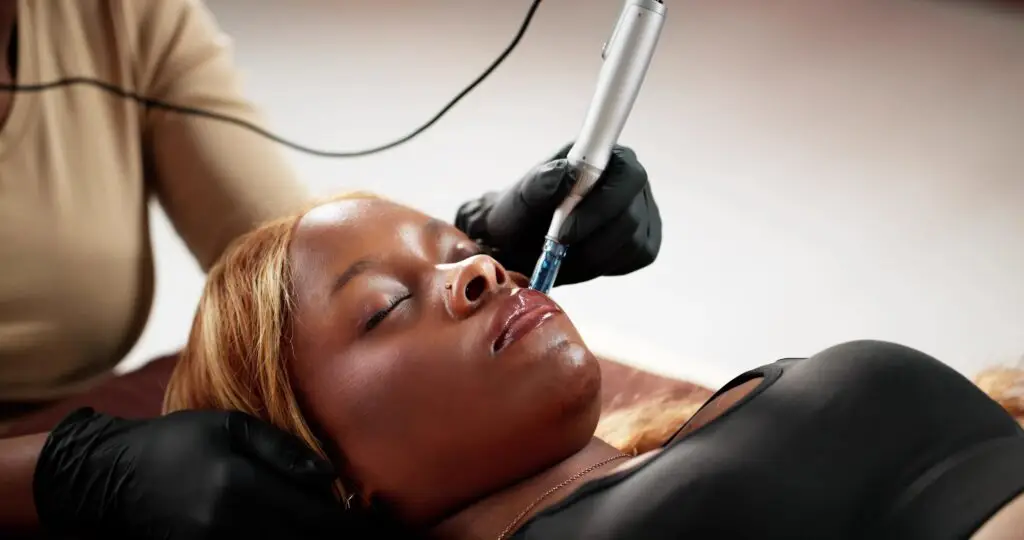
Under Florida scope-of-practice statutes, microneedling performed at therapeutic depth is considered a medical procedure. It must be performed by, or under direct supervision of, a licensed medical professional — an MD, DO, PA, APRN (which includes nurse practitioners), or an RN under physician supervision. Estheticians, who fall under cosmetology licensure rather than medical licensure, are restricted to superficial cosmetic depth.
This isn’t a technicality. It’s a recognition that microneedling at medical depth has clinical realities cosmetic-grade microneedling does not:
Why this matters specifically in Miami Beach. Miami’s aesthetic market is one of the largest in the country, with hundreds of providers across a wide spectrum of training, licensure, and equipment. The same word — microneedling — appears on the menus of medical clinics, esthetician studios, and wellness spas alike, often at similar price points. The results, however, are not interchangeable. Asking who is performing your microneedling, what device they are using, and what license or credential authorizes them to do it is not rude. It is the right question — and one you should feel comfortable asking any provider, including us.
At South Florida Face and Body, your medical microneedling is performed by Kelly Wolfe, MSN, APRN, FNP-BC — Florida APRN License #11005134 — using an FDA-cleared Class II medical device with single-use sterile cartridges. No exceptions, no rotating staff, no handoffs.
Microneedling is one of the most versatile tools in medical aesthetics. The honest framing: it does some things exceptionally well, some things adequately, and a few things poorly. Here is the breakdown.
Rolling, boxcar, and shallow ice-pick scars respond exceptionally well to medical microneedling. The procedure stimulates new collagen to fill the scar bed from below, gradually leveling depressed scars with surrounding skin. A common Miami Beach concern: post-adolescent acne scars made more visible by years of strong overhead sun. Series of 4–6 sessions delivers visible softening.
Years of Miami Beach UV exposure produce a particular pattern of skin damage: irregular pigmentation, sun freckles (lentigines), dullness, leathery texture. Medical microneedling at proper depth triggers epidermal turnover and dermal remodeling that visibly fades pigmentation and rebuilds tone. Especially useful for patients with darker skin (Fitzpatrick IV–VI) for whom many laser treatments carry hyperpigmentation risk. Pairing microneedling with the right topicals matters — see which skincare actives to use at every age.
Pores enlarge when the supporting dermal collagen around them weakens — which is exactly what microneedling rebuilds. Patients consistently report smaller, less-visible pores and a smoother, more refined skin texture starting 4–6 weeks after the first session. The cumulative effect across a 3-session series is often the most-noticed change by friends and partners.
Surgical scars (C-section, breast augmentation, plastic surgery) and stretch marks (striae) on the abdomen, thighs, and breasts respond well to medical microneedling at deeper settings. Best results when treatment begins after a scar has matured (typically 3+ months post-surgery for surgical scars; striae respond at any age but newer pink/red stretch marks respond best). Multi-session protocol with deeper needle settings.
For fine lines around the eyes, perioral lines, and early neck or chest laxity, medical microneedling rebuilds dermal collagen in a way topical retinoids and over-the-counter products cannot. For deeper wrinkles caused by repeated muscle motion, neuromodulator (Botox, Dysport, Xeomin) addresses the cause; microneedling improves the surrounding skin quality. Wondering how to sequence these treatments across the year? See our yearly skincare treatment plan guide. For the bigger picture on why skin loses firmness in the first place, see our guide to preventing and reversing the effects of aging.
Scalp microneedling stimulates dormant follicles and improves the delivery of topical treatments and regenerative serums into the scalp. Most effective for early-stage androgenetic alopecia, post-partum shedding, and traction-related thinning. Often combined with exosome or PDRN serums for amplified follicular signaling, and with topical minoxidil or oral medications as part of a comprehensive hair plan. See our hair restoration page for the full protocol.
The neck and décolleté show Miami's sun history before the face does — necklace lines, crepe texture, dyschromia from years of low V-necks and convertible drives. Medical microneedling at appropriate depth rebuilds dermal collagen in tissue that has thinner skin and fewer sebaceous glands than the face, where most other modalities are harder to use safely. Often combined with hyperdilute Radiesse for amplified results.
Deep volume loss (hollow cheeks, deep tear troughs) — needs filler or biostimulator, not microneedling. Significant skin laxity from major weight loss or post-pregnancy — usually needs surgical or energy-based tightening (RF microneedling, Ulthera). Active acne — wait until lesions clear; treating active acne risks spreading bacteria. Deep "11s" between the brows or crow's feet from muscle motion — neuromodulator is the answer, not microneedling. Kelly will tell you honestly when microneedling is the wrong tool.
RF microneedling is one of the most heavily-marketed treatments in the Miami aesthetic market. The honest framing: it is a real and useful technology, but it is over-prescribed, it is the wrong choice for many of the patients who book it, and in October 2025 the FDA issued a formal safety communication about complications associated with the device category. Here is what that actually means for your decision.
Traditional medical microneedling creates micro-channels using fine needles, triggering a collagen and elastin response purely through mechanical wound healing. RF (radiofrequency) microneedling — sold under brand names like Morpheus8, Potenza, Vivace, Genius RF — delivers radiofrequency energy through the needle tips, generating heat in the deeper dermis and subcutaneous fat for additional remodeling and tightening.
RF microneedling is the better choice when the patient has significant skin laxity, deeper structural concerns (lower-face sagging, jowls, neck banding in patients not yet ready for surgery), or wants to address subcutaneous fat reduction along with surface skin quality. It is more aggressive, has longer downtime (often 5–7 days versus 2–3), and is significantly more expensive per session — usually $1,500–$3,000 versus $400 per area for SkinPen at South Florida Face and Body.
Traditional medical microneedling is the better choice when the patient is treating skin texture, pores, acne scars, sun damage, fine lines, hyperpigmentation, or mild laxity — which is most patients. It is also the right choice for darker skin types where RF energy can occasionally cause adverse pigmentation reactions in untrained hands.
| Medical Microneedling | RF Microneedling (Morpheus8 / Potenza) | Cosmetic Microneedling (Esthetician) | |
|---|---|---|---|
| Mechanism | Mechanical micro-injury at therapeutic depth | Mechanical injury + radiofrequency heat Deepest | Superficial mechanical micro-injury |
| Needle depth | 0.5–2.5 mm | 0.5–4.0 mm (some platforms 7+ mm) | ≤0.5 mm |
| Who performs it (Florida) | Medical provider (MD, PA, APRN) | Medical provider (MD, PA, APRN) | Esthetician (scope-limited) |
| Best for | Texture, pores, acne scars, sun damage, fine lines, Fitzpatrick I–VI Most patients | Significant laxity, deeper structural concerns, subcutaneous fat | Surface glow, product penetration only |
| Downtime | 2–3 days redness | 5–7 days redness, swelling, possible grid pattern | Same day to overnight redness |
| Typical Miami Beach cost | $400 per area | $1,500–$3,000 per session | $150–$400 per session |
| Sessions to result | 3–6 spaced 4–6 wk | 3 spaced 4–6 wk | Variable; results often modest |
On October 15, 2025, the FDA issued a safety communication regarding radiofrequency (RF) microneedling devices — the category that includes Morpheus8, Potenza, Vivace, and Genius RF. The agency cited reports of serious complications including burns, scarring, fat loss, disfigurement, and nerve damage with use of these devices for dermatologic or aesthetic skin procedures.
The FDA’s guidance to patients is straightforward: RF microneedling is a medical procedure — not a cosmetic treatment — and should only be performed by a licensed health care provider with specific training and experience on the device they are using. Patients are advised to ask which device will be used and to discuss the benefits and risks before scheduling.
What this means for South Florida Face and Body patients. The microneedling Kelly performs is traditional medical microneedling with SkinPen Precision — mechanical micro-injury only, no radiofrequency energy delivered into the tissue. The FDA’s October 2025 communication is specific to RF microneedling devices and does not apply to non-RF SkinPen microneedling. If you are considering RF microneedling specifically (Morpheus8 or comparable) for laxity that falls outside what traditional microneedling can address, Kelly will refer you only to providers with verifiable RF training and platform-specific experience, and she will help you think through the FDA’s questions before you book.
The right question is not “which is better?” — it is “which is right for what I want to fix?” If you have a Miami Beach face that needs texture, tone, and pore work, medical microneedling is the answer. If you have significant lower-face laxity that filler won’t solve and you aren’t yet considering surgery, RF microneedling may be the answer — and given the FDA’s October 2025 safety communication, the provider’s specific training and device experience matter more than ever. Kelly will tell you honestly which applies to you.
SkinPen microneedling creates thousands of micro-channels into the dermis. Those channels can be used to deliver regenerative serums directly into the tissue that just opened up to receive them. This is where the add-ons earn their place.
Exosomes are nano-sized extracellular vesicles secreted by stem cells (commercial preparations are typically derived from human umbilical cord mesenchymal stem cells). They contain hundreds of signaling proteins, growth factors, and microRNAs that amplify the skin’s regenerative response. Applied topically immediately after SkinPen treatment, they penetrate the open micro-channels and reach the dermal layer where fibroblasts respond.
Exosomes are particularly useful for acne scarring, post-inflammatory hyperpigmentation (common in Miami Beach patients with skin of color), surgical scar revision, and inflammatory skin concerns. The evidence base is younger than for traditional growth-factor therapies but has been compelling enough that exosomes have become the most-requested microneedling add-on at South Florida Face and Body. They add $200 to a session.
More on how exosomes work and what to expect: microneedling with exosomes explained.
PDRN is a serum of fragmented DNA molecules — most commonly derived from purified salmon sperm DNA, which shares a remarkably similar structure to human DNA. The DNA fragments bind to adenosine receptors on skin cells, stimulating fibroblast activity, accelerating tissue repair, and improving the local microcirculation that supports collagen and elastin production. It has been a mainstay of Korean and European aesthetic medicine for over a decade and is increasingly available in well-credentialed U.S. practices.
PDRN is particularly effective for sun-damaged skin, fine lines, post-inflammatory pigmentation, and any concern where the goal is comprehensive tissue regeneration rather than a single growth-factor signal. It also tends to be exceptionally well-tolerated, with minimal post-procedure inflammation. Patients with sensitive or reactive skin frequently respond better to PDRN than to exosomes. PDRN adds $200 to a session.
More on how polynucleotides work and what to expect: salmon sperm (PDRN) facials explained.
You’ll see PRP (platelet-rich plasma) and PRF (platelet-rich fibrin) marketed everywhere in Miami — and they are legitimate, well-studied therapies. Kelly does not offer them.
The reason is not philosophical, it is practical. PRP and PRF require an in-office blood draw, centrifugation, and immediate use. Exosomes and PDRN deliver comparable or superior regenerative signaling without the blood draw, without the variability that comes from each patient’s individual platelet count and growth-factor concentration, and without the time cost added to each appointment. For Kelly’s patient population — busy professionals, parents, and patients flying in from out of town — the consistency and simplicity of off-the-shelf regenerative serums has produced better outcomes than the blood-derived alternatives. If you specifically want PRP or PRF, Kelly will refer you to a colleague.
Are add-ons worth it? Honest answer: it depends on the indication. For overall skin texture and tone, SkinPen alone delivers excellent results. For acne scarring, surgical scars, hyperpigmentation, and hair restoration, the add-on is often worth the cost. Kelly will not upsell you on an add-on you don’t need — and will tell you when SkinPen alone is the right call.
Most Miami Beach practices won’t publish a microneedling price — and many of the ones who do are quoting cosmetic-depth microneedling at medical-grade rates. Below is what Kelly actually charges as of 2026, for true medical-depth SkinPen microneedling performed by a Florida-licensed APRN. One treatment area equals roughly a full-face-sized region of skin: face, neck, décolleté, scalp, abdomen, or any comparable section.
Face, neck, décolleté, scalp, or comparable area. Includes 20–30 min prescription topical numbing and post-treatment skincare.
Stem-cell-derived regenerative serum, applied topically post-treatment. Per session.
Polydeoxyribonucleotide serum for fibroblast stimulation. Per session.
Per-session, no package commitment. You pay for each session as you receive it. There is no pre-paid “package of six” that locks you into a series before you have seen what one session does for your skin. Many Miami Beach practices structure their pricing to discount only when you pre-pay for a full series — Kelly does not. Pay session by session, evaluate at your 6-week follow-up, and decide together whether to continue.
How $400 per area compares. Medical microneedling in Miami Beach commonly runs $500–$900 per session at comparable single-area pricing, with the high end driven by Brickell and Bal Harbour rent rather than better outcomes. Quotes meaningfully below $400 in Miami Beach often reflect cosmetic-depth microneedling sold under medical microneedling marketing — which is a different procedure entirely, as covered earlier on this page. Kelly’s $400 per area sits at the low end of the legitimate medical-grade market and stays there because the practice is owner-operated, with no injector commissions or franchise overhead built into the price.
Knowing what to expect during recovery is half the battle — especially in Miami Beach, where strong UV during the healing window can compromise your result. Here is the realistic timeline.
Predictable, manageable, and worth planning around.
Skin looks and feels like a moderate sunburn. Pinpoint redness, possible mild swelling, warm to touch.
Redness fades to a flush. Skin may feel tight and slightly rough. Mild flaking begins for some patients.
Visible redness resolves. Skin appears normal but is still healing on a cellular level. Continue gentle skincare.
"Glow" appears — initial texture and tone improvement become visible. Pores look smaller. Skin feels firmer.
Full effect of session settled. Decide with Kelly whether to repeat for cumulative result. Remodeling continues 6 months.
A medical microneedling appointment runs 60–75 minutes door to door. The procedure itself is 20–30 minutes. The rest is the topical numbing and the clinical assessment that makes the result.
South Florida Face and Body sits in Suite 414 at 1000 5th Street, at the southern tip of Miami Beach. From SoFi, Kelly draws microneedling patients across the barrier islands, across the causeway to mainland Miami, and from as far south as Key Biscayne.
SoFi is one of the most accessible aesthetic locations in the city — close to the MacArthur Causeway for Brickell, Downtown, and Key Biscayne patients, and a clear straight shot up Collins or Indian Creek for Mid-Beach, Surfside, and Bal Harbour. Most patients arrive in under twenty minutes door-to-door.
1000 5th Street, Suite 414 · Miami Beach, FL 33139
Parking: Attached parking garage at $4/hr. Free street parking around the building during business hours (one nearby zone is pay-to-park — signage indicates).
Geography matters in microneedling planning because lifestyle matters. A SoFi resident who runs the South Pointe boardwalk every morning at 7am needs a different sun-protection conversation than a Brickell finance executive who lives in air-conditioned conference rooms. A Key Biscayne sailing family has different cumulative sun damage than a Mid-Beach professional. Microneedling timing — when in your year to start a series, when to pause around heavy sun exposure, when to layer with prescription skincare — is built around the life you actually live in this city, not a template.
Patients regularly travel to South Florida Face and Body from Brickell (8 minutes via the MacArthur), Mid-Beach, Surfside and Bal Harbour, and Coral Gables for medical microneedling specifically. The draw: a single-provider practice where the person planning your series is the person performing every session.
Microneedling is one of the most poorly-explained procedures in Miami Beach. Patients walk in having had microneedling before without knowing whether what they had was cosmetic or medical, what device was used, what depth was set, or whether the operator was even legally authorized to do it. The conversation that follows — about what their previous treatments could and couldn’t have done, and about what a true medical-depth series can accomplish — is the work that makes the result.
Kelly Wolfe is a Florida-licensed Advanced Practice Registered Nurse (APRN #11005134) and board-certified Family Nurse Practitioner (FNP-BC), credentialed by the American Nurses Credentialing Center. She holds a Master of Science in Nursing from the University of Miami, plus a Master’s in Biochemistry from Missouri State University, where her graduate research focused on metabolism and the role of leptin and appetite-suppressing hormones. That biochemistry background is uncommonly relevant for collagen-induction work — the growth-factor cascade, the type III to type I collagen transition, how regenerative serums like exosomes and PDRN actually signal to fibroblasts — these are the conversations she actually has at consultation, not pamphlet-level summaries. She is also a Certified Functional Medicine Practitioner.
And she owns the practice. The person you book with is the person who treats you — every session of every series.
Same-week consultations available. South of Fifth, Miami Beach.
Kelly is the owner of South Florida Face and Body. A board-certified Family Nurse Practitioner trained at the University of Miami, she holds advanced degrees in nursing, biochemistry, and biology, with graduate research focused on metabolism and the role of leptin and appetite-suppressing hormones. She practices at the intersection of functional medicine and aesthetic injection — meaning the conversations in her treatment room often go beyond the syringe to consider sleep, hormones, metabolism, and inflammation as part of how your skin and face actually present.
Licensed as an Advanced Practice Registered Nurse in the State of Florida (APRN #11005134), Kelly brings more than three decades of experience in health, fitness, and clinical practice. She has performed aesthetic injections in South Florida for over a decade and has trained alongside the dermatology and plastic surgery community that built Miami’s aesthetic reputation.
She is the one who answers your text message. She is the one who calls the day after your injection.
From your first consultation through every follow-up, you’ll work directly with Kelly — one injector, one set of hands, one consistent plan.
Advanced practice registered nursing with a focus on family health and primary care.
Research focused on metabolism and the role of leptin and appetite-suppressing hormones.
Research with a strong foundation in human physiology, cellular biology, and biochemistry.
National certification in family practice and primary care.
Authorized to diagnose, treat, and prescribe medications in the State of Florida.
Advanced training in root-cause diagnostics, hormone optimization, metabolic health, and integrative wellness.
Over 30 years helping clients achieve sustainable health and wellness transformations.
Common questions from Miami Beach patients considering medical microneedling. If yours isn't covered here, Kelly is happy to answer directly — text or call.
Medical microneedling is collagen induction therapy performed by a licensed medical provider using an FDA-cleared Class II medical device at therapeutic needle depths — typically 0.5 mm to 2.5 mm. It reaches the papillary and reticular dermis, where collagen and elastin are produced, triggering a genuine wound-healing cascade.
Cosmetic microneedling, performed by estheticians, is limited to superficial depths (generally 0.5 mm or less) under Florida scope-of-practice law. It is not the same procedure clinically or legally.
The difference matters most for acne scars, surgical scars, stretch marks, deeper wrinkles, significant pore size, and skin laxity — concerns that live in the dermis and cannot be meaningfully addressed by superficial cosmetic microneedling. Curious about the biology behind how new skin actually forms after treatment? Read our full breakdown of how it rebuilds new skin.
Medical microneedling at South Florida Face and Body is $400 per treatment area, performed with SkinPen Precision — the only FDA-cleared Class II microneedling device. One treatment area is a full-face-sized region of skin, so face ($400), neck ($400), décolleté ($400), scalp ($400), abdomen ($400), or any comparable section are each priced the same.
Exosome add-on: +$200 per session. PDRN add-on: +$200 per session. Pricing is per-session — Kelly does not require pre-paid series packages or long-term commitments. You evaluate at your 6-week follow-up and decide together whether to continue.
Most patients need 3–6 sessions spaced 4–6 weeks apart, with the exact number depending on indication. You pay $400 per area per session — there are no pre-pay packages or series commitments to navigate.
Treatment count depends on what you are correcting:
Overall skin texture, dullness, and fine lines: 3 sessions spaced 4–6 weeks apart usually delivers visible results.
Acne scars, surgical scars, or stretch marks: 4–6 sessions spaced 4–6 weeks apart.
Deeper concerns or significant cumulative sun damage (common in long-time Miami Beach patients): 6 sessions, sometimes with maintenance every 6–12 months.
The 6-week follow-up appointment tells us whether to extend the series, modify depth, or add an adjunct like exosomes or PDRN.
Yes. In Florida, microneedling performed at therapeutic depths is considered a medical procedure under state scope-of-practice law. It must be performed by, or under the direct supervision of, a licensed medical provider — MD, DO, PA, APRN, or RN under physician supervision.
Estheticians in Florida are limited to superficial cosmetic microneedling. A patient who received microneedling from a non-medical provider may have actually received cosmetic microneedling at a depth that does not reach the dermis — which is why their results may have underwhelmed.
Kelly Wolfe is a Florida-licensed APRN (#11005134), which authorizes her to perform medical microneedling at full therapeutic depth.
Traditional medical microneedling creates controlled micro-channels using fine needles, triggering a collagen and elastin response through mechanical wound healing.
RF microneedling (Morpheus8, Potenza, Vivace, Genius RF) adds radiofrequency energy delivered through the needle tips, generating heat in the deeper dermis and subcutaneous tissue for additional remodeling and skin tightening.
RF microneedling is more aggressive, more expensive ($1,500–$3,000 per session), has longer downtime (5–7 days versus 2–3), and is most useful for significant skin laxity or deeper structural concerns.
An important safety note: on October 15, 2025, the FDA issued a safety communication about RF microneedling devices, citing reports of burns, scarring, fat loss, disfigurement, and nerve damage. The FDA emphasized that RF microneedling is a medical procedure that should be performed only by a licensed health care provider with specific training on the device being used. The FDA’s communication is specific to RF devices and does not apply to traditional non-RF SkinPen microneedling. (Read the FDA safety communication.)
Standard medical microneedling with SkinPen is the correct first-line choice for most patients addressing texture, pores, fine lines, mild scarring, or sun damage. Kelly will tell you honestly which is appropriate for your skin at consultation.
SkinPen Precision is the only microneedling device with full FDA Class II clearance specifically for facial microneedling. Every other “medical microneedling” device on the market either operates under more limited clearances, off-label use, or no FDA clearance at all.
What that matters for in practice: SkinPen uses sealed, single-use, sterile cartridges (eliminating cross-contamination risk between patients), maintains consistent needle depth across the treatment field (other devices can vary), and has the most robust clinical evidence base in dermatology and aesthetic medicine.
The device matters because at therapeutic depth, consistency and sterility translate directly into safety and result quality. South Florida Face and Body uses SkinPen Precision for every medical microneedling treatment — face, neck, décolleté, body, and scalp.
Most patients describe medical microneedling as a mild scratching, vibrating sensation rather than sharp pain. Before treatment, Kelly applies a prescription-strength compounded topical anesthetic — typically BLT (benzocaine, lidocaine, tetracaine) — for 20–30 minutes, which substantially reduces sensation.
Areas like the forehead, lip border, and hairline tend to be slightly more sensitive. Discomfort during treatment is typically rated 2–4 out of 10 by patients. The prescription-strength numbing cream used at medical clinics is one of the things estheticians legally cannot offer.
Most patients have skin that looks and feels like a moderate sunburn for 24–48 hours, with pinpoint redness and possible mild swelling. By day 3, redness fades to a flush; by day 5, skin appears normal but is still healing on a cellular level.
Critical for Miami Beach: avoid direct sun exposure, makeup, exercise, saunas, swimming pools, and the ocean for 24–72 hours. Strong UV during the healing window is a leading cause of post-inflammatory hyperpigmentation — a complication that takes months to fade. If your calendar includes a beach day or boat day during recovery, we reschedule.
Yes — and the combination often outperforms SkinPen alone for certain indications.
Exosomes are nano-sized extracellular vesicles containing signaling proteins, growth factors, and microRNAs that amplify the regenerative response. Particularly useful for acne scarring, hyperpigmentation, and inflammatory skin concerns. More on the treatment: microneedling with exosomes, explained.
PDRN (polydeoxyribonucleotide) is a fragmented-DNA serum that stimulates fibroblast activity and accelerates tissue repair. It is exceptionally well-tolerated and often the better choice for sensitive or reactive skin. Read more about PDRN and salmon sperm facials.
Kelly does not offer PRP or PRF — she has chosen the exosome and PDRN add-ons specifically because, in her practice, the evidence and patient response have been stronger than with blood-derived alternatives. If you specifically want PRP or PRF, she will refer you to a colleague. Either way, she will help you decide whether an add-on is worth it for your indication — and won’t upsell you on one you don’t need.
Yes. Scalp microneedling, often combined with exosome or PDRN serums, stimulates dormant hair follicles and improves the delivery of regenerative compounds and topical treatments into the follicular environment.
It is most effective for early-stage androgenetic alopecia, post-partum shedding, and traction-related thinning, and is frequently combined with topical minoxidil or oral medications as part of a comprehensive hair restoration protocol.
Typical protocol: 4–6 sessions spaced 4 weeks apart, with maintenance every 3–6 months. See our hair restoration page for the full plan.
Most healthy adults with concerns about skin texture, pores, fine lines, acne scarring, surgical scars, stretch marks, hyperpigmentation from sun damage, or mild skin laxity are candidates. Medical microneedling is safe for all Fitzpatrick skin types I–VI — an important consideration in Miami Beach, where many patients have skin of color and have been turned away from laser-based treatments.
You are not a candidate if you are pregnant or breastfeeding, have active acne, eczema, or rosacea in the treatment area, have a history of keloid scarring, have used Accutane (isotretinoin) within the past 6 months, have an active skin infection, or have a bleeding disorder. Disclose all medications and skin conditions at consultation.
Possibly, but it requires planning. Patients on anticoagulant or antiplatelet medication (aspirin, warfarin, Plavix, Eliquis, Xarelto, etc.) face an increased risk of bruising and prolonged pinpoint bleeding during and after microneedling. Disclose all current medications during your consultation.
Important: do not discontinue any anticoagulant on your own — always consult your prescribing physician before making any changes to these medications. Kelly will coordinate with your prescribing physician if any modifications are appropriate.
Week 1: Initial “glow” — improved skin brightness and a slight tightening sensation. Largely due to inflammation and superficial healing.
Week 2–4: Real textural and tone improvement (smoother skin, reduced pore visibility, softening of fine lines) becomes visible as new collagen begins to organize.
Week 6–8: Full effect of a single session settles. This is when we evaluate at follow-up.
6 months: Peak collagen remodeling continues for up to 6 months after a full series. Photos at week 6, week 12, and 6 months will tell you what your skin is actually doing.
1000 5th Street, Suite 414, Miami Beach, FL 33139 — in the South of Fifth (SoFi) district at the southern tip of Miami Beach. We’re 8 minutes from Brickell, 10 from Mid-Beach, 19 from Bal Harbour.
Parking: Attached parking garage at $4/hr. Free street parking around the building during business hours (one nearby zone is pay-to-park — signage will indicate). We’re also a short walk from the South Beach Loop trolley.
Phone: (786) 529-1860. Hours: Monday–Friday 10am–6pm, Saturday 10am–2pm.