
Non-surgical neck and chest rejuvenation using hyperdilute Radiesse, FDA-approved Radiesse for the décolleté, and Botox for platysmal bands.
Neck and décolleté rejuvenation in Miami Beach is built around one clinical fact most patients don't know: horizontal neck lines and vertical platysmal bands are two different problems with two different treatments. Horizontal lines are a collagen problem and want a biostimulator. Vertical bands are a muscle problem and want Botox. Treating one with the other wastes money and doesn't change how the neck looks. Kelly Wolfe, MSN, FNP-BC built a procedure around that distinction — matching a treatment to your lines.
4.9 60 Google Reviews
OWNER · UNIVERSITY OF MIAMI-TRAINED · FL APRN #11005134
Horizontal neck lines (tech neck), vertical platysmal bands, crepe-y or sun-damaged décolleté, thin neck skin, jawline-to-neck definition loss, GLP-1 / Ozempic-related neck volume loss.
30–45 minutes for a hyperdilute Radiesse, FDA-approved Radiesse for the décolleté, or platysmal band Botox session. Most patients return to errands the same hour.
Hyperdilute Radiesse and Radiesse for the décolleté: gradual rebuild over 12 weeks across 2–3 sessions. Botox for platysmal bands: effect at 7–14 days, lasting 3–4 months.
$500–$1,800 per session. Comprehensive multi-session biostimulator plans run $2,400–$5,400 across 2–3 sessions. Per-treatment pricing, in writing, before any injection.
Kelly Wolfe, MSN, APRN, FNP-BC — Florida APRN #11005134, University of Miami-trained. Microcannula technique for biostimulators. Every injection, every appointment.
1000 5th Street, Suite 414 — South of Fifth, Miami Beach 33139. $4/hr attached garage; free street parking nearby during business hours. 8 minutes from Brickell.
The neck and décolleté show aging earlier and more visibly than the face for three reasons most patients underestimate: the skin is thinner, the structural support is weaker, and the area gets far more sun exposure with far less sunscreen than the face. Most patients arrive surprised that their neck looks ten years older than their face. They aren't wrong about the discrepancy — they've simply protected their face more carefully for decades.
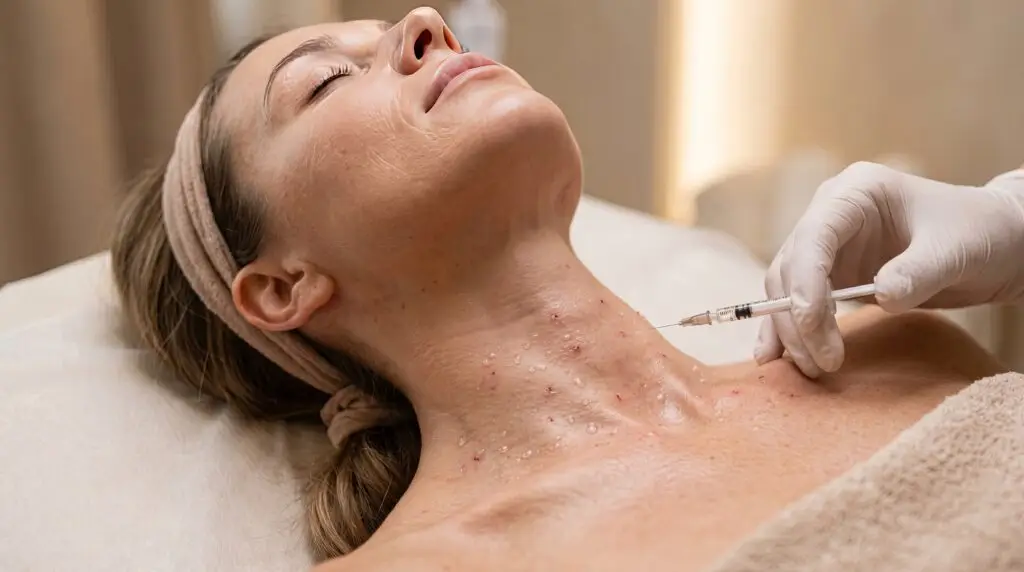
The good news is that the neck and décolleté respond predictably to the right treatment. The bad news is that the wrong treatment doesn’t work, and the most common mistake — using filler for vertical bands or Botox for horizontal lines — costs patients real money for no result. The right starting point is identifying which lines you actually have, which leads to which treatment will actually work.
The other reality patients don’t usually consider until consultation: the neck and the décolleté are two related but distinct zones. The neck has muscle (the platysma) that contributes to vertical band formation. The décolleté has no platysma — it’s primarily a skin-quality and sun-damage zone. Treating both areas at once is common and appropriate, but the treatment logic for each is different.
This is the single most important conversation in neck rejuvenation. Treating the wrong type of line with the wrong modality is the most common mistake patients make — and the most common reason a previous neck treatment didn’t work.
The “necklace lines” that run across the front of the neck. They are visible at rest, etched into the skin from years of repeated neck flexion (now accelerated by phone use — “tech neck”) plus cumulative collagen loss and sun damage.
These are a skin and collagen problem, not a muscle problem. Botox does not improve them meaningfully.
Hyperdilute Radiesse — calcium hydroxylapatite biostimulator injections that rebuild collagen across 2–3 sessions, 6 weeks apart.
The cord-like vertical structures that pop forward when you tense your neck, speak, or look down. They are formed by the platysma muscle pulling forward as it ages and loses its smooth attachment to surrounding tissue.
These are a muscle problem. Biostimulator filler does not improve them — the issue is muscle activity, not collagen.
Botox or Dysport injected into the platysma along the band — sometimes called a Nefertiti lift. Lasts 3–4 months.
Most patients have both — horizontal lines from collagen loss and vertical bands from platysma aging — and need both treatments to actually improve the look of their neck. A patient who has only had filler will still see vertical bands. A patient who has only had Botox will still see horizontal lines. The right plan addresses both, in the right sequence.
The neck (from jawline to collarbone) and the décolleté (from collarbone to the upper chest) are anatomically continuous but age differently. The neck has the platysma muscle and is treated for both collagen and muscle issues. The décolleté has no significant muscle contribution to its lines — it ages almost entirely through sun damage and collagen loss. Treating both areas in the same session is common because patients usually notice both areas simultaneously, and the biostimulator that rebuilds neck collagen is the same one that rebuilds chest collagen.
AGING PROBLEMS WE TREAT IN-HOUSE
RELATED BUT DISTINCT ANATOMICAL ZONES
SESSIONS FOR A FULL BIOSTIMULATOR PLAN
On April 8, 2026, the FDA approved Radiesse for the treatment of wrinkles in the décolleté area in patients age 22 and older — making Radiesse the first and only regenerative biostimulator approved in the U.S. for both face and body, and the only injectable specifically cleared for décolleté wrinkles. The new indication formalizes a clinical use case Kelly has performed for years with strong off-label evidence behind it. It also gives décolleté patients the assurance of an on-label treatment for one of the most visible — and earliest — areas to show signs of aging.
Read the Merz Aesthetics announcement → · Learn more about Radiesse →
Most patients arrive describing their neck as "old" or "crepey" without identifying which specific change is doing the visible aging. Below are the four primary aging presentations and the right treatment for each. Many patients have two or three simultaneously — which is why combination plans across the neck and décolleté are usually the right answer.
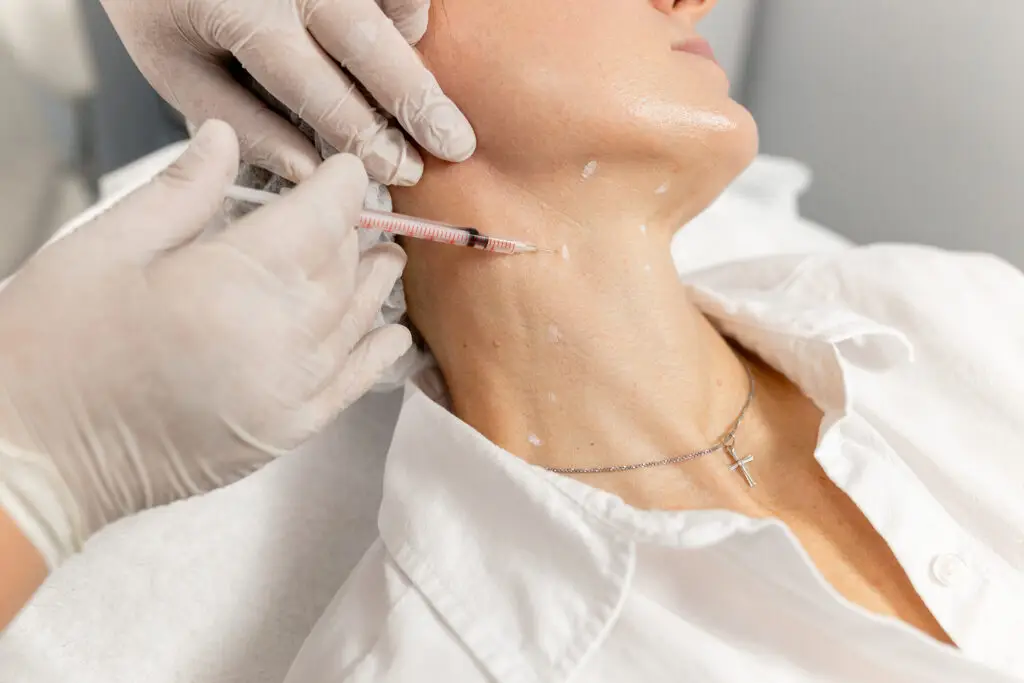
"Necklace lines" running across the front of the neck. The most common presentation, increasingly seen in patients under 50 from constant phone and tablet use ("tech neck"). The mechanism is repeated neck flexion combined with collagen loss and sun damage. Treated with hyperdilute Radiesse across 2–3 sessions to rebuild dermal collagen.
The cord-like vertical structures that pop forward when you tense your neck or speak. Caused by the platysma muscle pulling forward as it ages. Botox or Dysport injected into the platysma along the band relaxes the muscle, softens the band, and produces subtle jawline lift — sometimes called a Nefertiti lift. Repeats every 3–4 months.
The chest skin between the collarbones and the upper breast — exposed daily to sun, rarely protected by sunscreen, and one of the first areas to develop visible photoaging. As of April 2026, Radiesse is the first and only injectable FDA-approved for the treatment of wrinkles in the décolleté area in patients age 22 and older. Treated subdermally across 2–3 sessions and most often combined with the neck in the same visit. For severe pigment damage or deep texture changes, laser care at a dermatology referral may also be indicated.
The reality for most patients: the neck has horizontal lines AND vertical bands, the chest has crepe-y skin, and some sun damage is present. A typical comprehensive plan combines hyperdilute Radiesse across 2–3 sessions for the neck and Radiesse for the décolleté under its new FDA indication — with Botox added at session one for the platysmal bands. For severe sun damage, a dermatology partner handles the laser piece.
Hyperdilute Radiesse is the workhorse for the neck — peer-reviewed clinical evidence backs it specifically in this area. For the décolleté, Radiesse received FDA approval in April 2026 as the first and only injectable indicated for décolleté wrinkles in patients age 22 and older. Botox or Dysport (Nefertiti lift technique) is the right answer for vertical platysmal bands. For severe sun damage or significant skin laxity, Kelly refers to a trusted Miami dermatology partner for laser treatments or to a plastic surgeon for surgical neck lift evaluation.

Standard Radiesse diluted typically 1:4 with saline and lidocaine, then injected subdermally across the neck. Stimulates collagen and elastin production without focal volumization. Clinical studies have specifically demonstrated improvement in neck laxity, horizontal lines, and dermal thickness after 2 sessions 6 weeks apart, assessed both clinically and by ultrasound. Most patients need 2–3 sessions; results emerge over 12 weeks and last 18–24 months. The default first-line treatment for horizontal neck lines and tech neck. Read more about Radiesse →
Horizontal neck lines (tech neck), dermal thinning of the neck. The default for collagen-driven neck aging.
On April 8, 2026, the FDA approved Radiesse for the treatment of wrinkles in the décolleté area in patients age 22 and older — making it the first and only regenerative biostimulator approved in the U.S. for both face and body, and the only injectable specifically cleared for décolleté wrinkles. Calcium hydroxylapatite stimulates collagen, elastin, and other essential proteins in the chest's thin, sun-exposed skin, with results that can last up to two years. At South Florida Face and Body, the décolleté is typically treated in the same visit as the neck across a 2–3 session series 6 weeks apart, using a blunt-tip microcannula for safety and comfort. Read more about Radiesse →
Crepe-y chest, "necklace lines" running into the upper chest, sun-aged décolleté. The FDA-approved décolleté indication.
Botox or Dysport injected into the platysma muscle along the vertical neck bands relaxes the muscle, softens the band's prominence, and produces subtle jawline lift as the downward pull of the platysma is reduced. Sometimes called a Nefertiti lift after the elongated, sculpted neckline of the Egyptian queen. Results show in 7–14 days and last 3–4 months — these are repeating maintenance treatments by design. Often combined with Radiesse work in the same session: Botox addresses the bands, Radiesse addresses the lines. Read more about Botox → · Read more about Dysport →
Vertical platysmal band prominence, patients wanting subtle jawline lift, the muscle-driven half of comprehensive neck plans.
For severe sun damage and pigment irregularity — deep pigment damage, solar elastosis, leathery photoaged texture — laser care (CoolPeel CO2, fractional CO2, Morpheus8 RF microneedling, or IPL) is the right tool. South Florida Face and Body does not perform laser treatments; Kelly refers to a trusted Miami dermatology partner. Many patients combine her Radiesse plan for the collagen and muscle issues with laser care at the referral for the pigment and resurfacing work.For significant skin laxity or severe "turkey neck" — when biostimulator injection and Botox can't practically address the cord prominence and skin redundancy — surgical neck lift is the appropriate intervention. Kelly will tell you honestly at consultation if your anatomy is better served by surgery and can refer to a Miami plastic surgeon she trusts. Patients who want a one-time permanent solution rather than ongoing maintenance cycles often choose surgery for the same reason.
Not performed — referred. Both pathways complement Kelly's Radiesse and Botox work for comprehensive neck rejuvenation.
GLP-1 medications cause rapid weight loss, and the neck and décolleté are areas where the change becomes visible relatively early. Patients on GLP-1 therapy often notice their neck looking older — more visible platysmal bands, more prominent horizontal lines, thinner skin texture, more visible collarbone prominence — within 6 to 12 months of starting treatment. The face, neck, hands, and chest tend to show volume loss in tandem.
The treatment approach for GLP-1-related neck aging differs in two meaningful ways:
The volume loss is diffuse and the skin is thinner. GLP-1 patients lose volume across the entire neck and chest rather than in specific zones. Hyperdilute Radiesse for the neck and Radiesse for the décolleté (under its new April 2026 FDA indication) rebuild the dermal foundation across the whole area predictably — restoring skin quality rather than placing focal volume.
Volume loss may still be progressing. Patients still actively losing weight on GLP-1 may need treatment revisited in 6 months. The better strategy is conservative dosing across a multi-session series that can adjust as the patient’s body continues to change, rather than committing to a large single-visit plan.
Kelly’s background is genuinely relevant here. Her biochemistry master’s research focused on metabolism and appetite-suppressing hormones — the same pathway GLP-1 medications act on. Combined with her Certified Functional Medicine Practitioner credential, the consultation about restoring volume on an ongoing GLP-1 regimen is clinically informed rather than templated. Disclose your GLP-1 medication at consultation — it changes the treatment plan meaningfully.
Months of GLP-1 therapy before neck volume change appears
The neck and décolleté aftercare protocol is different from the face. The neck moves constantly throughout the day (talking, eating, looking around), gets pressure from clothing collars and necklaces, and gets sun exposure every time you leave the house with anything less than a full turtleneck. Most competitor pages skip neck-specific aftercare entirely — and patients lose results because of it.
The aftercare that matters for keeping your neck rejuvenation result:
Neck and décolleté rejuvenation is appropriate for most patients with visible neck or chest aging, but there are scenarios where it produces poor outcomes or where a different intervention serves the patient better. Naming them honestly:
How we approach this differently. An honest “no” or “not yet” or “wrong treatment” saves the patient’s money and protects the result. If your neck concern is better addressed by surgery, by laser care, by waiting for weight stabilization, or by treating an underlying skin condition first, Kelly will say so directly and point you toward the right next step — even when that means a referral out rather than treatment here.
Most Miami Beach practices won’t publish neck and décolleté pricing. We do, because patients deserve to know what they’re walking into before they sit down. The ranges below reflect what Kelly actually charges as of 2026. Your written quote at consultation reflects your specific plan.
Neck-focused. Most patients need 2–3 sessions.
FDA-approved April 2026. Often combined with the neck in the same visit.
Per session. Repeats every 3–4 months by design.
What you pay for. Per-treatment pricing means your invoice reflects exactly what was performed. Comprehensive multi-session Radiesse plans (covering neck and chest across 2–3 sessions) typically run $2,400–$5,400 across 2–3 months. Combination plans that also address platysmal bands at session one add $500–$900. No opaque “treatment package,” no upcharge for cannula versus needle — microcannula is the default for Radiesse placement. For patients who also need laser care at a dermatology referral, that work is priced separately by that practice.
How Miami Beach compares to the national average. Miami Beach neck and décolleté pricing runs roughly 10–20% above the national average, reflecting overhead realities. Quotes meaningfully above the ranges published here usually reflect Brickell or Bal Harbour rent — not better outcomes.
South Florida Face and Body sits in Suite 414 at 1000 5th Street, at the southern tip of Miami Beach. From SoFi, Kelly draws neck and décolleté patients across the barrier islands, across the causeway to mainland Miami, and from as far south as Key Biscayne. The neck and chest are areas where multi-session commitment matters — making consistent provider continuity and a stable office location meaningful for patients planning a 2–3 session biostimulator series across several months.
SoFi is one of the most accessible aesthetic locations in the city — close to the MacArthur Causeway for Brickell, Downtown, and Key Biscayne patients, and a clear straight shot up Collins or Indian Creek for Mid-Beach, Surfside, and Bal Harbour. Neck and décolleté patients often appreciate combining their visit with face treatments (cheek filler, jawline filler, temple filler) in the same appointment — making the discreet office and consistent provider continuity practical.
1000 5th Street, Suite 414 · Miami Beach, FL 33139
Geography matters in neck and décolleté planning more than patients realize. A Brickell executive with daily on-camera meetings has different timing constraints than a Mid-Beach patient with a flexible schedule. A Bal Harbour patient who travels frequently and presents at events has different recovery-window considerations than a Coconut Grove patient with a quieter calendar. Kelly factors lifestyle into session timing and treatment sequencing — not just the neck at rest.
A neck and décolleté appointment at South Florida Face and Body runs 30–45 minutes. The actual injection is 15–25 minutes. The rest is the conversation about which lines you have, which treatments will work for each, and how to sequence the multi-session plan most patients need.
Neck and décolleté rejuvenation at South Florida Face and Body is built around one clinical fact most Miami practices skip: horizontal lines and vertical bands are different problems with different treatments. The patients who switch to Kelly often arrive having had previous Botox for “tech neck” (which doesn’t work) or previous filler for platysmal bands (which doesn’t work either) — and they’re frustrated because nobody explained the distinction at consultation. The conversation here begins with that distinction and works backward from it: which lines do you actually have, which treatment is right for each, and how do we sequence the plan over the months it takes to rebuild collagen properly.
Kelly Wolfe is a Florida-licensed Advanced Practice Registered Nurse (APRN #11005134) and board-certified Family Nurse Practitioner (FNP-BC), credentialed by the American Nurses Credentialing Center. She holds a Master of Science in Nursing from the University of Miami, plus a Master’s in Biochemistry from Missouri State University, where her graduate research focused on metabolism and the role of leptin and appetite-suppressing hormones. The biochemistry background is genuinely relevant for neck work in two specific ways. First, the calcium hydroxylapatite chemistry of hyperdilute Radiesse — how the microspheres at 1:4 dilution stimulate fibroblasts in the subdermal layer of the neck specifically, and how Radiesse stimulates collagen and elastin in the thin décolleté skin under its new FDA indication — is real clinical reasoning behind why the protocol works. Second, the GLP-1 patient conversation: metabolism, leptin, and appetite-suppressing hormones are the same pathway Ozempic and Wegovy act on, meaning the consultation about restoring neck and chest volume on ongoing GLP-1 therapy is clinically informed rather than templated. She is also a Certified Functional Medicine Practitioner.
The continuity matters for neck and décolleté work because this is a multi-session commitment. A Radiesse series across 2–3 sessions over 2–3 months is the design of the protocol, and the practitioner who placed your first session is the only one who can read whether the collagen is integrating as expected and whether session two needs more, less, or different placement. Kelly is the practitioner from consultation through every follow-up visit.
Same-week consultations available. South of Fifth, Miami Beach.
Kelly is the owner of South Florida Face and Body. A board-certified Family Nurse Practitioner trained at the University of Miami, she holds advanced degrees in nursing, biochemistry, and biology, with graduate research focused on metabolism and the role of leptin and appetite-suppressing hormones. She practices at the intersection of functional medicine and aesthetic injection — meaning the conversations in her treatment room often go beyond the syringe to consider sleep, hormones, metabolism, and inflammation as part of how your skin and face actually present.
Licensed as an Advanced Practice Registered Nurse in the State of Florida (APRN #11005134), Kelly brings more than three decades of experience in health, fitness, and clinical practice. She has performed aesthetic injections in South Florida for over a decade and has trained alongside the dermatology and plastic surgery community that built Miami’s aesthetic reputation.
She is the one who answers your text message. She is the one who calls the day after your injection.
From your first consultation through every follow-up, you’ll work directly with Kelly — one injector, one set of hands, one consistent plan.
Advanced practice registered nursing with a focus on family health and primary care.
Research focused on metabolism and the role of leptin and appetite-suppressing hormones.
Research with a strong foundation in human physiology, cellular biology, and biochemistry.
National certification in family practice and primary care.
Authorized to diagnose, treat, and prescribe medications in the State of Florida.
Advanced training in root-cause diagnostics, hormone optimization, metabolic health, and integrative wellness.
Over 30 years helping clients achieve sustainable health and wellness transformations.
Common questions from Miami Beach patients considering neck and décolleté rejuvenation. If yours isn't covered here, Kelly is happy to answer directly — text or call.
Neck and décolleté rejuvenation in Miami Beach runs $500 to $1,800 per session depending on the treatment.
Hyperdilute Radiesse for the neck: $1,200–$1,800 per session (most patients need 2–3 sessions).
Radiesse for the décolleté (FDA-approved April 2026): $1,200–$1,800 per session; often combined with the neck in the same visit.
Botox or Dysport for platysmal bands: $500–$900 per session (repeats every 3–4 months by design).
Comprehensive multi-session Radiesse plans typically run $2,400–$5,400 across 2–3 sessions. Every quote is in writing before any procedure. If laser pigment correction is also indicated, that work is referred to a dermatology partner and priced separately. Full pricing breakdown above.
This is the most important clinical distinction in neck rejuvenation and the one most patients do not know.
Horizontal neck lines (“necklace lines”) run across the front of the neck. They are visible at rest. Caused by collagen loss, sun damage, and repetitive neck flexion (tech neck). Treated with hyperdilute Radiesse over 2–3 sessions to rebuild dermal collagen.
Vertical platysmal bands are the cord-like vertical structures that pop forward when you tense your neck or speak. Caused by the platysma muscle. Treated with Botox or Dysport injected into the muscle along the band (sometimes called a Nefertiti lift).
Using the wrong treatment for the wrong line is the most common mistake — Botox does not improve horizontal lines, and filler does not improve vertical bands. Full clinical breakdown above.
Tech neck refers to horizontal lines and creasing on the front of the neck caused by repeatedly flexing the neck forward to look at phones, tablets, and laptops. The treatment depends on severity:
Mild tech neck: Topical retinoids and rigorous SPF can slow progression but won’t reverse existing lines.
Moderate-to-significant tech neck: Hyperdilute Radiesse rebuilds dermal collagen across 2–3 sessions — the most effective injectable approach.
Severe tech neck with deeply etched lines: The Radiesse plan often combined with laser resurfacing at a dermatology referral.
Botox has limited role in tech neck because the lines are collagen-driven, not muscle-driven. Full tech neck section above.
Yes — peer-reviewed clinical studies have specifically demonstrated that hyperdilute Radiesse (calcium hydroxylapatite diluted at a 1:4 ratio with saline and lidocaine) produces measurable improvement in neck laxity, horizontal lines, and dermal thickness across 2 sessions 6 weeks apart, assessed both clinically and via ultrasound.
The product is injected subdermally rather than as focal volume, and the mechanism is collagen stimulation rather than direct volume restoration. Most patients need 2–3 sessions for full effect; results emerge over 12 weeks and last 18–24 months. Read more about Radiesse →
A Nefertiti lift is a specific Botox or Dysport injection technique that targets the platysma muscle along the jawline and the vertical neck bands to produce subtle jawline definition and neck tightening. The name comes from the elongated, sculpted neckline of the Egyptian queen Nefertiti.
The injection points run along the lower jawline and down the vertical platysmal bands, relaxing the downward pull of the platysma so the jawline appears more lifted. Results last 3–4 months. Most effective for patients with mild-to-moderate platysmal band prominence and a desire for subtle jawline refinement.
Yes — as of April 8, 2026. The U.S. Food and Drug Administration approved Radiesse for the treatment of wrinkles in the décolleté area in patients age 22 and older. This makes Radiesse the first and only regenerative biostimulator with an FDA indication that covers both face and body, and the only injectable specifically cleared for décolleté wrinkles.
The new indication adds to Radiesse’s existing FDA approvals for facial wrinkles and hand rejuvenation. In Miami Beach, this is the same product Kelly has used as the workhorse for neck and chest collagen rebuild — the new approval simply formalizes a use case with strong clinical evidence behind it.
Yes — and you usually should treat both areas together because they age in coordination.
Crepe-y décolleté is dermal thinning of the chest skin, typically from cumulative sun exposure plus age-related collagen loss. Radiesse — now FDA-approved for décolleté wrinkles as of April 2026 — addresses it the same way it addresses the neck: subdermal placement to stimulate collagen across multiple sessions.
The neck and chest are treated in the same visit when both areas have similar concerns, and the result is a more cohesive rejuvenation than treating either area alone.
Yes — GLP-1 medications (Ozempic, Wegovy, Mounjaro, Zepbound) cause rapid fat loss throughout the body, and the neck and décolleté are areas where the change becomes visible relatively early.
Patients on GLP-1 therapy often notice their neck looking older — more visible platysmal bands, more prominent horizontal lines, thinner skin texture — within 6–12 months of starting treatment. The face, neck, hands, and chest tend to show volume loss in tandem.
The treatment approach for GLP-1-related neck aging often uses hyperdilute Radiesse for the neck and Radiesse for the décolleté across multiple conservative sessions, because the volume loss is diffuse and the goal is to rebuild dermal collagen rather than place focal volume. Read the full GLP-1 section above.
Most neck rejuvenation injections are well-tolerated with topical anesthetic.
For hyperdilute Radiesse and Radiesse for the décolleté: Kelly applies topical numbing for 20–25 minutes and uses a blunt-tip microcannula, which is more comfortable than sharp needle injection. Most patients describe the sensation as pressure rather than sharp pain.
For Botox in platysmal bands: A very fine needle delivers small doses; most patients tolerate it without topical anesthetic.
The neck is a less sensitive injection area than the lips or under-eyes for most patients.
Hyperdilute Radiesse and FDA-approved Radiesse for the décolleté: 18–24 months as the collagen scaffolding persists beyond the gel itself. Most patients maintain results with annual touch-ups.
Botox and Dysport for platysmal bands: 3–4 months. These are repeating maintenance treatments by design.
Laser treatments at a dermatology referral: 1–3 years with consistent sun protection.
Surgical neck lift: The procedure is one-time; underlying aging continues over time.
Recovery is typically minimal for injectable treatments. Mild swelling and tenderness for 24–72 hours; bruising (if any) resolves within 5–7 days. Most patients return to normal activity the next day.
The most important aftercare is strict SPF 50+ daily for at least 4 weeks post-treatment, sleeping on your back the first 1–2 nights, and avoiding heavy perfume or skincare on injection sites for 24 hours. Full aftercare protocol above.
If you require laser treatment at a referral practice, that recovery is longer — 2 days for IPL or non-ablative fractional, 7–10 days for ablative fractional or CO2.
Most healthy adults with visible signs of neck or décolleté aging — horizontal lines, vertical platysmal bands, crepe-y skin, sun damage, or some combination — are good candidates.
You may not be a good candidate if you have significant skin laxity exceeding what non-surgical treatment can address (surgical neck lift may serve you better), active skin infection or unhealed dermatitis on the neck or chest, ongoing aggressive GLP-1 weight loss where volume loss is still progressing, or unrealistic expectations that one session of any treatment will reverse decades of sun exposure. Full candidacy discussion above.
Disclose your full medical history at consultation, including any anticoagulant or antiplatelet medications. Do not discontinue any anticoagulant on your own — always consult your prescribing physician before making any changes to these medications.
Yes — and patients often do exactly this. Neck and décolleté work pairs naturally with cheek filler, jawline filler, temple filler, or any face treatment scheduled in the same visit.
For GLP-1 patients with diffuse facial AND neck volume loss, a combined Radiesse plan addressing both areas across 2–3 sessions is often the most efficient approach. Kelly will plan the sequencing at consultation based on what you want to settle when.
1000 5th Street, Suite 414, Miami Beach, FL 33139 — in the South of Fifth (SoFi) district at the southern tip of Miami Beach. We’re 8 minutes from Brickell, 10 from Mid-Beach, 19 from Bal Harbour. $4/hr in the attached garage; free street parking is available around the building during business hours (one nearby zone is metered). Phone: (786) 529-1860. Hours: Monday–Friday 10am–6pm, Saturday 10am–2pm.