
Non-surgical temple volume restoration using Restylane Lyft, Juvéderm Voluma, Sculptra, and Radiesse — placed with microcannula safety technique by a University of Miami-trained nurse practitioner who personally performs every injection.
Kelly Wolfe, MSN, FNP-BC built her temple practice around a discipline most Miami injectors don't make a centerpiece: the temples are anatomically one of the higher-risk filler zones, and microcannula technique is the default — not the upgrade. The temporal fossa is also one of the most underdiscussed areas of facial volume loss, particularly for the rising number of patients on GLP-1 medications experiencing rapid facial deflation. The right filler at the right depth produces a meaningful brow lift, refreshes the upper face, and restores the soft transition between forehead and cheek without ever announcing itself.
4.9 60 Google Reviews
OWNER · UNIVERSITY OF MIAMI-TRAINED · FL APRN #11005134
Sunken or hollow temples, age-related temporal fat atrophy, GLP-1 / Ozempic-related facial volume loss, descended outer brow, hooded upper eyelid appearance, gaunt or fatigued upper face.
30–45 minute appointment for 1–2 syringes. Most patients return to errands the same hour, full activity the next day.
HA filler (Restylane Lyft, Voluma): immediate result, fully settled by 2 weeks. Radiesse: immediate definition plus continued collagen build over 3 months. Sculptra: gradual rebuild over 12 weeks across 2–3 sessions.
$800–$1,200 per syringe. Most patients use 1–2 syringes total for both temples. Per-syringe pricing, in writing, before any injection.
Kelly Wolfe, MSN, APRN, FNP-BC — Florida APRN #11005134, University of Miami-trained. Microcannula technique by default. Every injection, every appointment.
1000 5th Street, Suite 414 — South of Fifth, Miami Beach 33139. $4/hr attached garage; free street parking nearby during business hours. 8 minutes from Brickell.
Hollow temples are one of the earliest visible signs of facial aging and one of the most underdiscussed — they age the upper face years before patients notice the change in a mirror. Restoring temporal volume produces three simultaneous improvements: a smoother forehead-to-cheek transition, a meaningful indirect lift of the outer brow, and the elimination of the shadowing that signals "tired" or "gaunt" in photographs. The change is small in volume terms but disproportionately large in how rested the face reads.
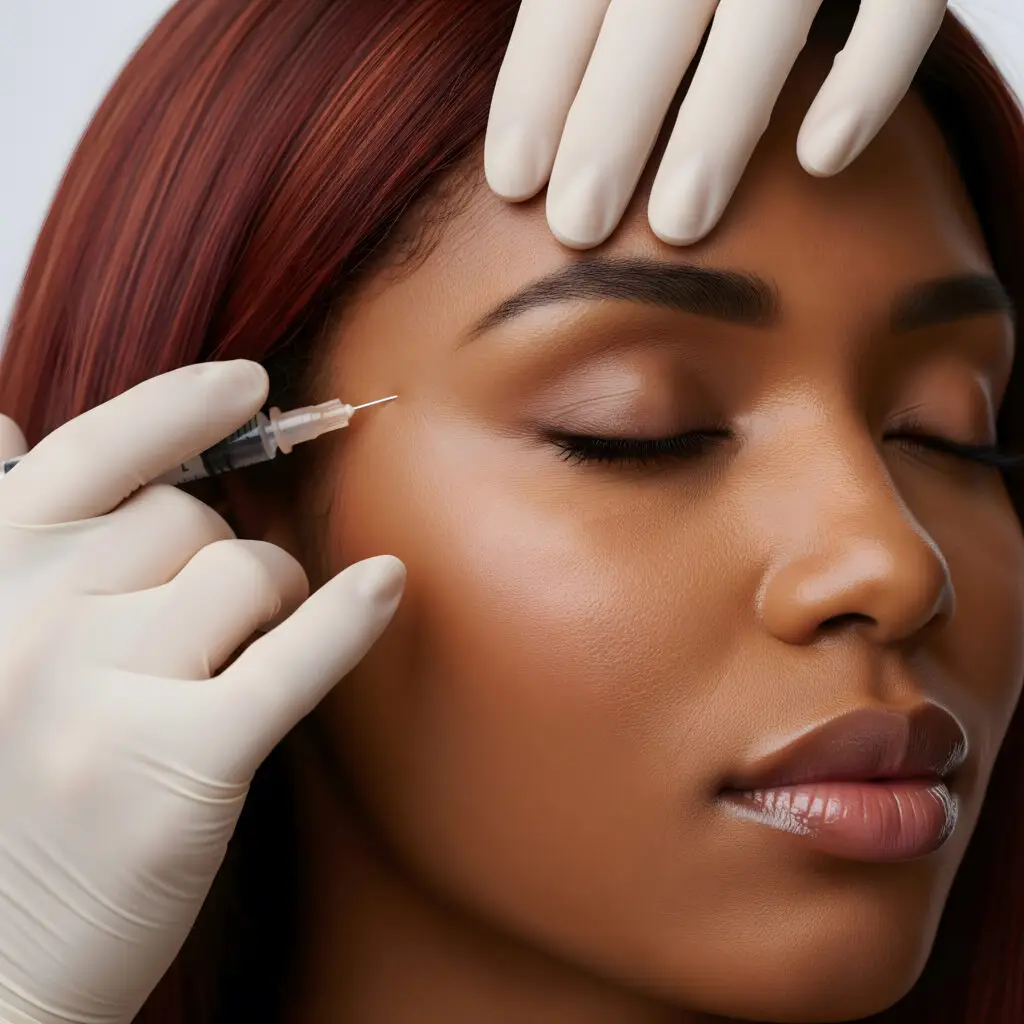
The temporal fossa is a small recess on each side of the head bounded by the forehead, the outer brow, the temporal hairline, and the upper cheek. In a youthful face it is gently full and supports the lateral brow. As facial fat pads atrophy with age — typically starting in the late 30s and accelerating through the 40s and 50s — the temporal fossa deflates, the outer brow descends, and the bony orbital rim becomes more visible. Patients often describe seeing themselves in side-profile photos and not recognizing the face that looks back.
Temple filler is the corrective intervention. Done well, it restores the volume the temple has lost, indirectly lifts the outer brow by providing structural support beneath it, and re-establishes the continuous soft contour between forehead and cheek. Done poorly — too much, too superficial, or in the wrong tissue plane — it produces visible overfilling that reads worse than the original hollowing. Restraint, microcannula technique, and conservative dosing matter more here than in almost any other facial filler area.
A temple filler treatment plan begins with mapping which of the four temple sub-zones are deflated and how much volume each one needs. The same patient might need significant restoration at the central temple but almost nothing at the temporal-cheek transition — or the opposite. Treating the temple as a single homogeneous area is the most common technical mistake in this procedure. The other is treating both sides identically; almost everyone has some asymmetry, and an injector who doses 0.5 mL per side regardless of starting anatomy will produce a more asymmetric result than they started with.
DISTINCT TEMPLE SUB-ZONES
FILLER PRODUCTS USED FOR TEMPLES
SYRINGES TOTAL FOR MOST PATIENTS
The temple is four zones, not one — anterior temple, central temple, posterior temple, and temporal-cheek transition. Each ages slightly differently and each wants a different placement strategy. Kelly maps which of yours are deflated and treats the ones that need it, in the proportion they need.
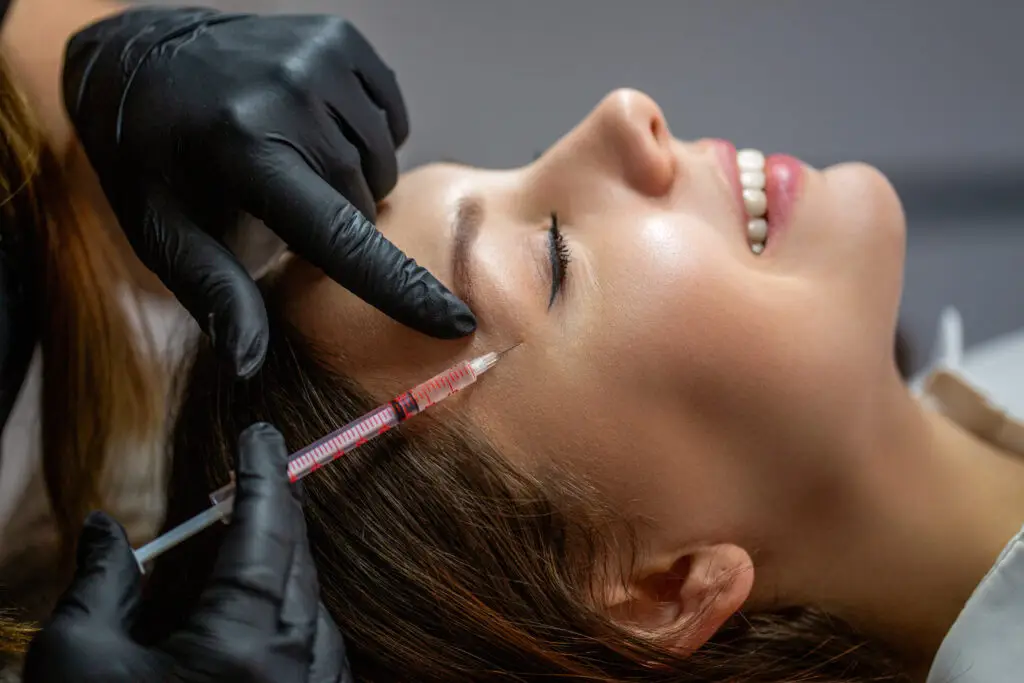
The portion of the temporal fossa just behind the outer brow tail. Restoring volume here produces the most visible brow-lift effect — the lateral brow is structurally supported and rises as a result. For patients seeking a non-surgical brow lift or improvement in hooded upper eyelid appearance from brow descent, this is the most important zone to address. Conservative dosing matters: a small amount of volume here produces visible lift; overdosing produces a swollen, unnaturally projected outer brow.
The deepest part of the temporal fossa, the area most visibly hollow in patients with significant temporal volume loss. Restoring volume here eliminates the dark shadow that signals "tired" in photographs and re-establishes the smooth contour between forehead and cheek. The default zone for first-time temple filler patients. The zone where GLP-1 patients usually need the most volume.
The portion of the temple nearest the hairline. Less frequently treated than the anterior and central zones, but important for patients with significant overall temporal atrophy or for those seeking complete restoration of the temporal contour. Small volume here smooths the transition into the hairline and improves how the face reads from a three-quarter angle. Often a final 0.1–0.2 mL refinement rather than a primary treatment zone.
The continuous line where the temporal fossa meets the upper cheek and zygomatic arch. A break in this transition — where the temple has deflated but the cheek is full, or the reverse — creates a visible "step" in the side profile. Filler here smooths the line, creating one continuous contour from forehead through cheek. Often best treated alongside cheek filler rather than in isolation, particularly for GLP-1 patients with broader facial volume loss.
Restoring volume to the temporal fossa indirectly lifts the outer brow, lateral canthus, and upper eyelid by providing structural support beneath them. For patients whose hooded upper eyelid appearance is caused by lateral brow descent — which is common in mid-life facial aging — temple filler can produce a visible brow lift without surgery. The change is often dramatic enough that patients describe feeling “less tired-looking” without being able to identify what changed.
The brow lift effect is most pronounced when filler is placed precisely in the anterior temple sub-zone, behind the outer brow tail. Patients with brow-descent-driven hooding — rather than true upper eyelid skin excess — are usually good candidates for this approach.
Temple filler is not a substitute for upper blepharoplasty when significant upper eyelid skin excess (dermatochalasis) is the cause of the hooded appearance. Kelly will assess at consultation whether your hooding is filler-responsive or surgery-responsive. If surgery would serve you better, she will refer to a Miami oculoplastic surgeon rather than inject filler that won’t deliver the result you want.
Restylane Lyft is the most common first choice for temple filler — its firmness suits the deep supra-periosteal plane and it integrates softly with the surrounding tissue. Juvéderm Voluma is the alternative when more structural projection is needed. Radiesse suits patients wanting longer-term collagen-stimulating support. Sculptra is the right answer for diffuse, gradual rebuild — particularly for GLP-1 patients with broader facial volume loss across multiple areas.
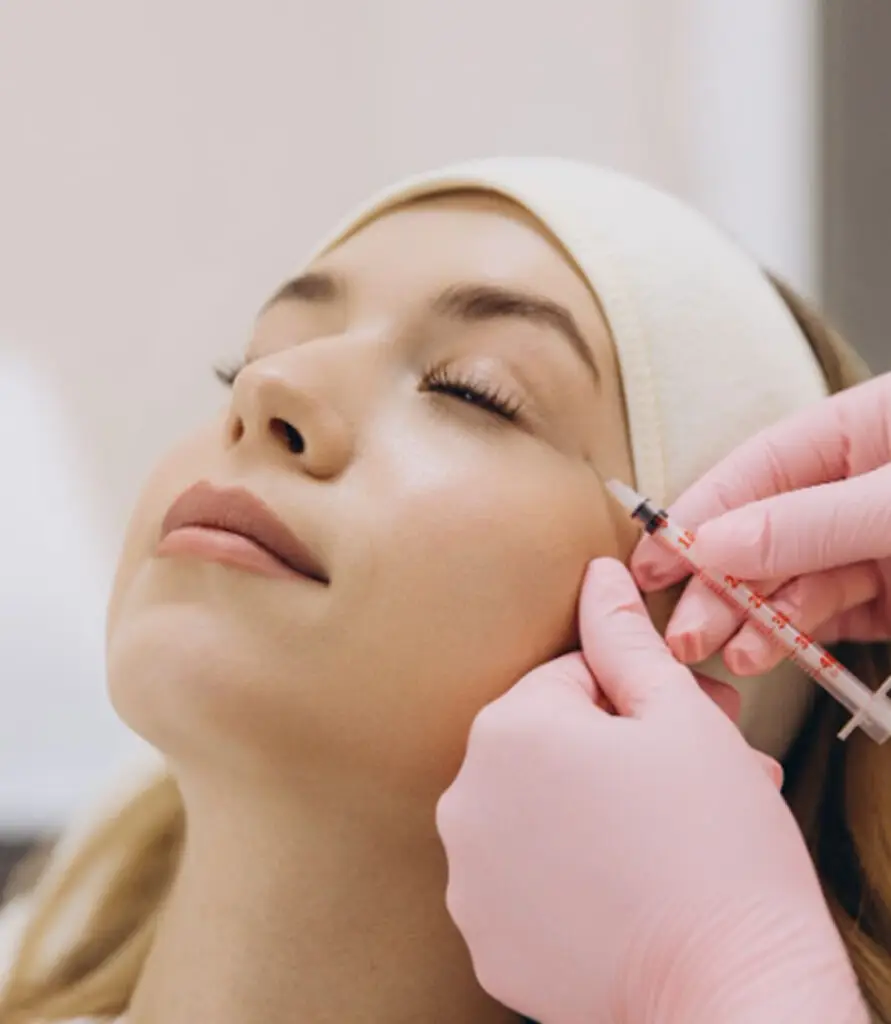
A cross-linked HA designed for structural support with softer integration than firmer products. The temple is where Restylane Lyft genuinely shines: firm enough to provide deep volume restoration against the temporal bone, soft enough to integrate naturally with the surrounding tissue without visible projection. Reversible with hyaluronidase. Lasts 12–18 months. The default first choice for most temple patients.
Most temple patients — first-time treatments, mild-to-moderate hollowing, patients who want HA's reversibility.
Cross-linked HA with the highest structural firmness in the Juvéderm line. The right choice for patients with more significant temporal hollowing who need stronger structural projection than Lyft provides, while keeping HA's reversibility advantage. Same hyaluronidase safety net as Lyft. Lasts 12–18 months at the temple. Particularly suited for patients seeking the maximum brow-lift effect from anterior temple placement.
Patients with significant temple hollowing or those wanting maximum brow-lift effect from temple placement.
Calcium hydroxylapatite microspheres in a carrier gel. Provides immediate structural volume AND stimulates collagen production over 3–6 months — meaning the temporal result becomes more durable over time rather than fading uniformly. Not reversible — a consideration. Best for patients who have already done HA filler in the temples successfully and want to extend the result, or for patients prioritizing longevity over reversibility. Read more about Radiesse →
Patients prioritizing longevity, those who have done HA temple filler successfully and want longer-acting structural support.
Poly-L-lactic acid that stimulates your own collagen production gradually over 12 weeks across 2–3 sessions spaced 6 weeks apart. The right choice when temple hollowing is part of broader facial volume loss — particularly for GLP-1 / Ozempic patients whose entire face has deflated rather than just the temples. Result emerges gradually and lasts 18–24 months as your own collagen scaffolding. Read more about Sculptra →
GLP-1 patients with diffuse volume loss, patients seeking gradual change nobody can identify, and those wanting the longest-lasting result.
The temporal fossa contains the superficial temporal artery — a significant blood vessel that runs vertically through the temple from the cheek toward the scalp — and a network of veins and smaller arteries. Temple filler is one of the higher-risk facial filler procedures because intravascular injection (accidentally placing filler into a blood vessel) can cause skin necrosis or, very rarely, vision changes if the artery communicates with the orbital circulation. This is not hypothetical; it is documented in the medical literature, and it is the reason temple filler is one of the procedures where injector experience and technique matter most.
Microcannula technique dramatically reduces this risk. A microcannula is a blunt-tipped instrument that pushes blood vessels aside rather than piercing them — fundamentally lower vascular injury risk than a sharp needle. At South Florida Face and Body, microcannula is the default for every temple injection, not an upgrade or an option. A single small needle pass creates the entry point, and the rest of the filler is delivered through the cannula. The procedure is also more comfortable (one needle stick instead of multiple), produces less bruising, and gives the injector better tactile feedback against the temporal bone.
Beyond technique, the safety discipline includes: anatomical mapping before injection (identifying the path of the superficial temporal artery on each patient’s specific anatomy), placement in the deep supra-periosteal plane against the temporal bone where the artery is not present, conservative dosing per session, and the practitioner having a hyaluronidase protocol ready in case any HA filler needs immediate dissolving. Kelly stocks hyaluronidase and has the protocol for vascular event management — a basic standard of care for any practitioner injecting in the temple region.
Months of GLP-1 therapy before facial volume loss appears
Most temple patients need 1 to 2 syringes total for both temples combined. A 1-syringe treatment (0.5 mL per side) is the most common starting point and produces clear, photographable volume restoration for mild-to-moderate hollowing. A 2-syringe treatment (1 mL per side) is appropriate for more significant hollowing or for GLP-1 patients with substantial volume loss. Going beyond 2 syringes in a single visit is rarely the right answer at the temple.
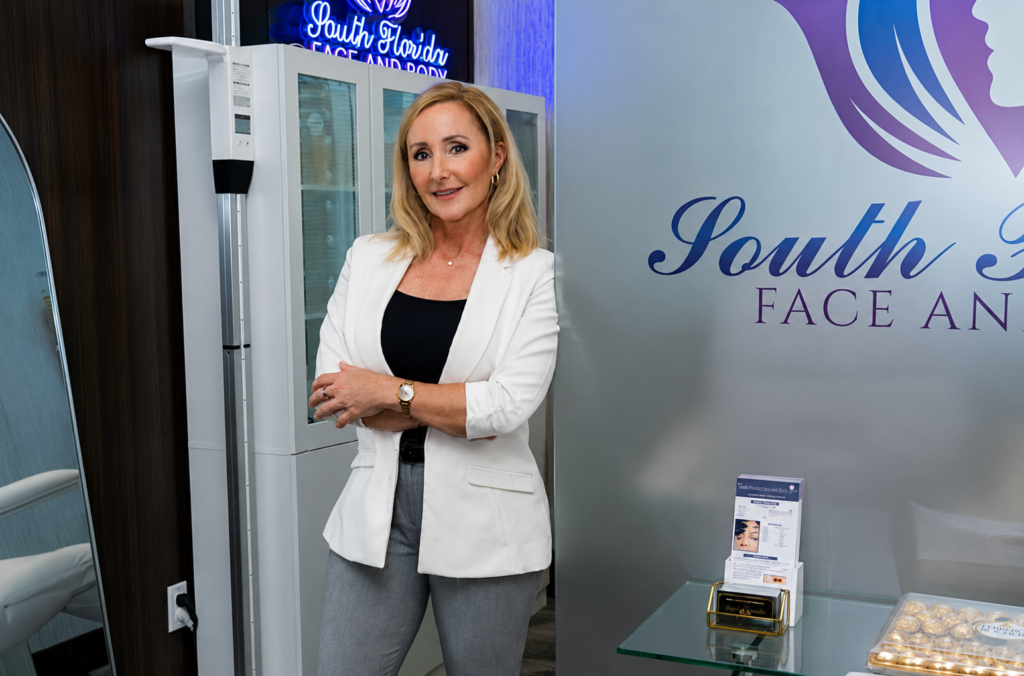
The temple is a smaller anatomical surface than the cheek or jawline, so meaningful change happens with less volume than in other areas. The right number for your face depends on starting anatomy, severity of hollowing, and whether the volume loss is focal (age-related) or diffuse (GLP-1-related).
The conservative approach is to dose for visible improvement at the lower end of the range, see how the temples settle at two weeks, and add at a follow-up only if needed. Most patients are surprised how much one well-placed syringe (half per side) accomplishes.
Most Miami Beach practices won’t publish a temple filler price. We do, because patients deserve to know what they’re walking into before they sit down. The ranges below reflect what Kelly actually charges as of 2026. Your written quote at consultation reflects your specific plan.
Per 1 mL syringe. The default choice for most temple work.
Voluma for HA reversibility; Radiesse for biostimulator longevity.
1–2 syringes for both temples combined. Sculptra plans priced per vial.
What you pay for. Per-syringe pricing means your invoice reflects exactly what was opened and placed. No per-zone surcharge, no opaque “treatment package,” no upcharge for cannula versus needle — microcannula is the default for temples and there is no extra cost for it. If one syringe accomplishes what we planned with two, you pay for one.
How Miami Beach compares to the national average. Miami Beach temple filler pricing runs roughly 10–20% above the national average, reflecting overhead realities. Quotes meaningfully above the ranges published here usually reflect Brickell or Bal Harbour rent — not better outcomes.
South Florida Face and Body sits in Suite 414 at 1000 5th Street, at the southern tip of Miami Beach. From SoFi, Kelly draws temple filler patients from across the barrier islands, across the causeway to mainland Miami, and from as far south as Key Biscayne. The temple is one of the higher-discretion procedures — many patients prefer the discreet office location, which matters particularly for executive patients and for the rising number of GLP-1 patients who prefer privacy around their volume-restoration appointments.
SoFi is one of the most accessible aesthetic locations in the city — close to the MacArthur Causeway for Brickell, Downtown, and Key Biscayne patients, and a clear straight shot up Collins or Indian Creek for Mid-Beach, Surfside, and Bal Harbour. Temple filler patients in particular appreciate the discreet office: no street-level med-spa presence, no waiting room visible from the lobby.
1000 5th Street, Suite 414 · Miami Beach, FL 33139
Geography matters in temple filler planning more than patients realize. A Brickell executive with daily on-camera conference rooms has different recovery-window constraints than a flexible-schedule Sunset Harbour patient. A Bal Harbour patient who travels frequently for work and presents in different time zones has different timing considerations than a Coconut Grove patient with a stable local schedule. Kelly factors lifestyle into product choice and appointment timing — not just the temple at rest.
A temple filler appointment runs 30–45 minutes depending on syringe count. The actual injection is 10–15 minutes — temple filler is one of the quicker injection procedures because the anatomical surface is smaller. The rest is anatomical mapping, multi-angle photography, and the careful conversation about whether this is the right intervention for your specific anatomy.
Temple filler at South Florida Face and Body is built around two disciplines most Miami injectors don’t emphasize. The first is making microcannula the default for the temple — not the upgrade — because the proximity of the superficial temporal artery makes blunt-tip technique a meaningful safety advantage rather than a comfort feature. The second is being clinically prepared for the rising number of GLP-1 patients with facial volume loss — a demographic that didn’t exist at scale two years ago and that most aesthetic practices are not equipped to advise well. Both wedges matter for the same reason: temple filler is one of the procedures where injector decisions, not injector marketing, determine outcomes.
Kelly Wolfe is a Florida-licensed Advanced Practice Registered Nurse (APRN #11005134) and board-certified Family Nurse Practitioner (FNP-BC), credentialed by the American Nurses Credentialing Center. She holds a Master of Science in Nursing from the University of Miami, plus a Master’s in Biochemistry from Missouri State University, where her graduate research focused on metabolism and the role of leptin and appetite-suppressing hormones. The biochemistry background changes how temple filler conversations actually go for GLP-1 patients. GLP-1 medications act on the same appetite-suppression and metabolic pathways Kelly studied at the graduate level — meaning the consultation about why a patient is losing facial fat, how to time volume restoration around continued therapy, and which product matches the rate of ongoing loss is a clinically informed conversation rather than a templated one. She is also a Certified Functional Medicine Practitioner.
The continuity matters for temple work because temple filler is the procedure where settled-result assessment matters most. Two-week photography to compare against pre-treatment baseline, twelve-week assessment for biostimulator products, and the same hands placing every maintenance syringe is what produces a temple result that looks balanced across sides and natural across years. The practitioner who placed your first session is the only one who can read whether the second session needs more, less, or different placement — and Kelly is that practitioner for every visit.
Same-week consultations available. South of Fifth, Miami Beach.
Kelly is the owner of South Florida Face and Body. A board-certified Family Nurse Practitioner trained at the University of Miami, she holds advanced degrees in nursing, biochemistry, and biology, with graduate research focused on metabolism and the role of leptin and appetite-suppressing hormones. She practices at the intersection of functional medicine and aesthetic injection — meaning the conversations in her treatment room often go beyond the syringe to consider sleep, hormones, metabolism, and inflammation as part of how your skin and face actually present.
Licensed as an Advanced Practice Registered Nurse in the State of Florida (APRN #11005134), Kelly brings more than three decades of experience in health, fitness, and clinical practice. She has performed aesthetic injections in South Florida for over a decade and has trained alongside the dermatology and plastic surgery community that built Miami’s aesthetic reputation.
She is the one who answers your text message. She is the one who calls the day after your injection.
From your first consultation through every follow-up, you’ll work directly with Kelly — one injector, one set of hands, one consistent plan.
Advanced practice registered nursing with a focus on family health and primary care.
Research focused on metabolism and the role of leptin and appetite-suppressing hormones.
Research with a strong foundation in human physiology, cellular biology, and biochemistry.
National certification in family practice and primary care.
Authorized to diagnose, treat, and prescribe medications in the State of Florida.
Advanced training in root-cause diagnostics, hormone optimization, metabolic health, and integrative wellness.
Over 30 years helping clients achieve sustainable health and wellness transformations.
Common questions from Miami Beach patients considering temple filler. If yours isn't covered here, Kelly is happy to answer directly — text or call.
Temple filler in Miami Beach runs $800 to $1,200 per syringe depending on the product. Restylane Lyft (the default choice for most temples) runs $800–$1,000 per syringe. Juvéderm Voluma runs $950–$1,200. Radiesse runs $800–$1,100 per 1.5 mL syringe. Sculptra (vial-based, for diffuse rebuild) runs $900–$1,200 per vial across 2–3 sessions.
Most patients use 1–2 syringes total for both temples, putting a session between $800 and $2,400. At South Florida Face and Body, every quote is in writing per syringe before any injection.
Temple filler typically lasts 12 to 24 months — often longer than filler in other areas because the temples have limited muscle movement to break down the product. Restylane Lyft and Juvéderm Voluma last 12–18 months. Radiesse lasts 12–18 months with continued collagen benefit. Sculptra emerges across 12 weeks and lasts 18–24 months as your own collagen scaffolding.
Most patients schedule a maintenance touch-up every 12–18 months. The temples are one of the more cost-efficient filler zones over time because of how long the result holds.
Most patients need 1 to 2 syringes total for both temples combined:
1 syringe (0.5 mL per side): Most common starting point. Clear, photographable result for mild-to-moderate hollowing.
2 syringes (1 mL per side): More significant hollowing or substantial GLP-1-related volume loss.
3+ syringes: Rarely the right answer for temples alone — usually a sign Sculptra across multiple sessions or staged HA over two visits is the better approach.
Kelly writes the exact syringe plan at consultation. Full breakdown above.
Yes — temple filler can produce a meaningful indirect lift of the outer brow, lateral canthus, and upper eyelid. The mechanism: restoring volume to the temporal fossa provides structural support beneath the outer brow tail, which lifts as a result.
For patients whose hooded upper eyelid appearance is caused by lateral brow descent (common in mid-life aging), temple filler can produce visible improvement without surgery. It is not a substitute for upper blepharoplasty when true upper eyelid skin excess is the cause. Read the full lift section above.
Restylane Lyft is the most common first choice — the right firmness for the deep supra-periosteal plane against the temporal bone, with soft tissue integration and HA reversibility.
Juvéderm Voluma is the alternative when more structural projection is needed.
Radiesse suits patients prioritizing longevity over reversibility.
Sculptra is the right answer for diffuse, gradual rebuild — particularly for GLP-1 patients. Full product breakdown above.
Temple filler is one of the higher-risk facial filler procedures because of the superficial temporal artery and the venous network in the area. The serious risk is intravascular injection — accidentally placing filler into a blood vessel, which can cause skin necrosis or, very rarely, vision changes.
The standard of care for safe temple filler is blunt-tip microcannula technique (which dramatically reduces vascular injury risk), thorough anatomical mapping before injection, and the practitioner having a hyaluronidase protocol ready for vascular events. At South Florida Face and Body, microcannula is the default for every temple injection. Read the full safety section above.
Sunken temples come from three primary causes:
Natural aging-related fat pad atrophy — typically gradual, appearing through the 40s and 50s.
Significant weight loss — facial fat is one of the early areas to deplete.
GLP-1 medications (Ozempic, Wegovy, Mounjaro, Zepbound) — what’s increasingly called “Ozempic face.” Tends to appear more rapidly (6–12 months of therapy) and is often part of broader facial volume loss.
The treatment approach differs by cause. For GLP-1 patients, Kelly often recommends Sculptra across multiple sessions rather than concentrated HA. Read the full GLP-1 section above.
Sometimes — it depends on what’s causing the hooding.
If the hooded appearance is caused by descent of the outer brow tail (common in mid-life facial aging), temple filler can lift the outer brow and meaningfully improve the hooded look.
If the hooding is caused by true upper eyelid skin excess (dermatochalasis), temple filler will not address it — upper blepharoplasty is the right intervention.
Kelly will assess at consultation whether your hooding is filler-responsive or surgery-responsive, and refer you to a Miami oculoplastic surgeon if surgery would serve you better.
Properly placed temple filler in the deep supra-periosteal plane against the temporal bone does not migrate meaningfully — the temporal fossa is a contained anatomical space with limited soft-tissue movement.
Migration can occur when product is placed too superficially, when too much volume is injected at once, or when the patient applies pressure or massages the area in the first few days. If you have prior temple filler that has migrated, hyaluronidase can dissolve HA filler and reset the area before new placement.
Most temple fillers are formulated with lidocaine, and Kelly applies topical anesthetic before the procedure. With microcannula technique (Kelly’s default for temples), the entry point is a single small needle pass — most patients describe the rest of the procedure as pressure rather than sharp pain.
Temple filler tends to be one of the better-tolerated injection areas because the temporal fossa is a relatively low-sensation zone compared with the lips or under-eyes.
Recovery is typically minimal. Mild swelling and tenderness for 24–72 hours; bruising, if any, resolves within 5–7 days. Most patients are comfortable in public the same day and return to full activity the next day.
Avoid strenuous exercise, saunas, hot yoga, and direct sun for 24–48 hours, and avoid pressure on the treated area or sleeping on the temples for 1–2 nights.
Most healthy adults with visible temporal hollowing — whether age-related, weight-loss-related, or GLP-1-related — are good candidates. Temple filler works particularly well for mild-to-moderate hollowing and for patients seeking a non-surgical brow lift effect.
You may be better served by a different intervention if your hooding is caused by true upper eyelid skin excess (blepharoplasty), if you have significant skin laxity (skin tightening procedures), if you have prominent vascular structures that elevate procedural risk, or if you are still actively losing weight on GLP-1 therapy. Full candidacy discussion above.
Disclose your full medical history at consultation, including any GLP-1 medications and any anticoagulant or antiplatelet medications (do NOT stop these on your own — consult your prescribing physician before any pre-injection adjustments).
Yes — and often should be. Temple filler combines naturally with cheek filler for full mid-face restoration (particularly for GLP-1 patients with broader volume loss), with Botox for forehead and outer-eye lines, and with under-eye filler for complete upper-face refresh. Sequencing matters — Kelly will plan the order at consultation based on what you want to settle when.
1000 5th Street, Suite 414, Miami Beach, FL 33139 — in the South of Fifth (SoFi) district at the southern tip of Miami Beach. We’re 8 minutes from Brickell, 10 from Mid-Beach, 19 from Bal Harbour. $4/hr in the attached garage; free street parking is available around the building during business hours (one nearby zone is metered). Phone: (786) 529-1860. Hours: Monday–Friday 10am–6pm, Saturday 10am–2pm.